Tuesday, August 25, 2009

In Other Magazines

Slate has broken my heart. They’ve decided to discontinue the “In Other Magazines” column.When the week came to a close “In Other Magazines” cobbled together a list of the most interesting feature stories “in other magazines”, directing readers to must-reads and steering them clear of must-misses. Insofar as it was a taste-making and agenda-setting enterprise, it was a valuable service.

Over the weekend I would settle on two or three long-form articles to get a broader perspective on a particular social debate. Perhaps the most illuminate piece of writing I came across this summer was Atul Gawande’s New Yorker article on the regional cost disparities of medical procedures in the state of Texas.

Comparing two demographically similar towns only 800-miles apart, Gawande found that the pre-capita cost of Medicare for McAllen, at roughly $15,000, was close to double that of El Paso, at $7,504. The conclusion Gawande draws is that culture matters. Medical professionals in McAllen had gotten into the habit of looking at the health care system as service industry, collecting fees for more and more procedures. Patient care was an afterthought.

For a time during the summer Gawande’s piece became the go to primer on the dysfunction of the United States health care system. Even president Obama, just as the house and senate were preparing to draft various pieces of health care legislation, implored members of congress to read the article. It’s likely that didn’t. But if they wanted to they could have happened upon it “In Other Magazines”. Alas.

But in its demise Slate has inaugurated “The Slatest”, the news aggregator to rival all other news aggregators. Collecting the top stories from the top newspapers, The Slatest will at the very least offer breadth. Most interestingly, though, is what Slate editor David Plotz has to say about the “New Cycle” as it exists today:
Overnight, newspapers launch the news. They publish stories clarifying the events of yesterday; they break their own investigative stories; they print zeitgeist-defining feature articles and op-eds. The morning brings Phase 2, when Web media reacts to the news. Bloggers and other sites respond to the news that broke overnight, and newsmakers push back against or try to exploit these stories. Phase 3, the buildup, comes in the afternoon, as the events of the day unfold—congressional action, a presidential gaffe, turmoil in Asia. The media break this news, and analyze how it fits together with yesterday's top stories. Opinion makers try to shape how the day's events will play on the night's cable shows and in tomorrow's newspapers. The next morning, it all starts over again.

This is crucial. The Slatest will attempt to capture this process and document what the “New Cycle” has become, a struggle by public interest groups to frame the social, political, and economic narratives of the day -- journalist and media organizations, in turn, synthesizing and refereeing these struggles. I hope amongst all of the news and events Slate doesn’t forget what’s going on in other magazines. They have important things to say too.

Wednesday, August 19, 2009

Notes on "Free Markets"

I

The “Free Market” isn’t really real. It never was. Even venerable classically liberal economists like David Ricardo and Adam Smith understood this proposition. Markets exist as arenas of exchange that facilitate the trade of goods and services between financiers, producers and consumers. Each one of these agents is a real live human being, or a legal fiction like the corporation, embedded into a number of different social institutions which, if we pay any attention to simple social organization, are compelled to act with a minimum level of cooperation and follow a rudimentary set of norms and rules that both condition behavior and require specific levels of good faith performance. The Laws of court are perhaps the best institutional example.

The state guarantees the enforcement of contracts and the protection of property rights. The fancifully abstracted notion that governments get in the way of contract or property disputes is to a certain extent misguided, often overlooking the alternative scenario of low-level social disruption or outright public disorder. Markets require the trust of civic legal institutions, tacitly abide by their rules, and prosper to the extent that they are seen as socially legitimate. Which, with respect to certain activities on the margins, for example the sale of marijuana, is always an ongoing and perennially contested soci-political debate. If you live in the real world, social institutions that regulate market activities are an inescapable reality.

It is also widely recognized that while markets operate within the context of these social institutions they are also continually shaping their development. When we look at the growth of the post-war automobile industry we see that urban and suburban planning mirrored the growing need for automobile use, and that the proliferation of single-family homes created a new market for a variety of different household consumer goods, from refrigerators to televisions to bed frames to coffee makers to lamps. The “Free Market” was responding to trends in social development insofar it was also determining them, and with the advent of the age of advertising the market began to shrewdly cater to an effervescence of a particularly new form of mass, modern culture.

But inside the complicated machine of modern society, specialized commercial industries, particularly in aerospace, medical and pharmaceutical sciences and agriculture, among others, worked within the ambit of government regulatory agencies, agencies that set the guidelines of market interaction and exchange. Quite naturally, though, these industries have begun to capture these regulatory agencies given their own propriety and specialized expertise. Oversight became a form of volunteerism where professional and regulatory bodies crafted, most often self-interestedly, the rules of the game.

Many of today’s market inefficiencies exist because markets aren’t free. Large regulatory agencies like the Canadian Medical Association in Canada are in positions of informational asymmetry, to which civil bureaucracies over-rely on their expertise and positional status, and come to accept their recommendations as sacrosanct. An alternative form of health service like naturopathy has been slowly but steadily expanding into the health care market as it has continued to gained social respectability. This, no doubt, has taken a considerable amount of social and political advocacy, along with a substantial amount of capital. “Free Markets” have all types of access costs, and we’d be fooling ourselves if we thought otherwise.


II


Fredrich Hayek’s insight that collectively planned economies lack the informational capacities to anticipate the prices and consumer trends in an incredibly unwieldy patchwork of decentralized markets is likely the strongest argument against most forms of command socialism. Distributing and allocating resources is something market capitalism has shown tremendous prowess in undertaking. But we’re not shadowboxing with the ghost of Lenin. If you live in a western industrialized country, you live with a system of rules that act as a bulwark toward your personal wellbeing.

Hayek understood the necessity of the rule of law, and sets of social and civic institutions that established the normative precepts for social behavior and trust. At a very crude level the state is a collection of the civil institutions, families, religious, scientific, cultural associations, markets, and municipal bodies that normalize and sanction contemporary conduct. These are all manifestation of “A Culture” and express themselves in all our social and linguistic interactions and exchanges. Markets do not exist in a vacuum outside of them.

III


If we accept that the market is a carefully staged competition that operates under the rules that its participants, to varying degrees, attempt to follow, then it’s easy to see why some misunderstand its essential nature. For some on the Left, competition is the inherent problem. Even while some aspire to equalize opportunity, the objective goal is to equalize outcomes. This would be incredibly self-defeating, given the diversity of not only human capacities but also the diversity in human aspirations. There isn’t only one market, there are many; and there isn’t only one status game, there are an innumerable amount of them.

For some on the Right, however, there is an almost ahistorical myopia of the reality of first-order injustices, those that have persisted over generations. The “Free Market” favors the most socially and physically capable, the thinking goes. Because racism and sexism don’t exist today, their long shadows aren’t being cast onto contemporary debates about race and gender. Equality of opportunity, it follows, equals not only equality of access -- and some might even suggest over-access – it should mean equality of outcomes. And since empirically this isn’t always the case, a far more pernicious claim against genetic inability is tacitly entertained. It’s as though the average male height of 5’6 in 1900 had increased to 5’10 in 2003 in a social, historical vacuum.

IV

Ultimately, the competitions that the market stages are neither free nor entirely efficient. They pit together the monopolies, statutorily regulated agencies, the public and private interest groups, me and you. They represent the largest competition of all: that contest to democratically seize the state through argument, debate, enticement, persuasion, and now more unsavorily, astounding sums of capital. They represents, quiet simply, the essence of politics.

Tuesday, June 02, 2009

The Problem with Complexity


Thomas Homer-Dixon's 2006 book The Upside of Down: Catastrophe, Creativity and the Renewal of Civilization was a sobering diagnosis of the incredible challenges that modern societies face. His general thesis was that complex societies ultimately have trouble dealing with ever greater degrees of complexity, and that these stresses tend to increase social, political, and economic disruption. Homer-Dixon identifies four different stresses:
  • population, both in growth rates among the rich and the poor and the incredible growth of megacities in poor countries
  • energy, especially the growing scarcity of conventional oil
  • environmental, particularly climate change and global warming
  • economic, disparities in income between developed and developing countries as well as income inequality within countries

Indeed none of these stresses are mutually exclusive, which is the major concern among a great many politicians, policymakers and citizens. But perhaps the most important part of the equation is energy. To lay out his argument Homer-Dixon uses a powerful historical example. The Roman Empire required an incredible amount of "high-quality" energy inputs, primarily in the form of grain, as the basis for its administrative and industrial integrity. As the amount of complexity to organize their social, political and economic systems rose, so to did the "high-quality energy" inputs needed to run these systems. Once the quality of energy inputs decreased, the complexity of Roman institutional systems began an irreversible decline.

What interests me most about Homer-Dixon's thesis is his notion of complexity. When confronted with with multiple crises, as we presently face today, societies have generally tended to create newer layers of complexity. In the political and policy responses to the Great Depression, the New Deal essentially offered a series of technical remedies to deal with the complexities of a phenomenally powerful yet socially pernicious market-capitalism. The Civil Rights Act is another example, although it was obviously responding to other types of societal and political stresses. Still, new levels of bureaucracy seem to be the most natural response to existential crises, and legislatively enacted distributions, whether they be physical goods or procedural recognitions of status claims, become the ultimate remedy.

An incredible market failure has socialized risk, leaving governments around the world the thankless task of reorganizing a whole array of institutions. How they manage this reorganization is an issue riddled with political, social, economic and philosophical dimensions. Dimensions on top of dimensions; dimensions embedded in dimensions. If complexity is the problem, how is it possible to deal with our present challenges? I hope to explore this question further.    


Tuesday, August 12, 2008

No Hope


IT’S DIFFICULT to quantify exactly how devastating a loss for the Democrats in the November presidential elections would be for me. As a Canadian ex-pat living and working in Japan I’m clearly not in a position to be directly impacted by their electoral misfortunes. As a “Citizen of the world”, the consequences are somewhat obvious; a continuing decline in American prestige and influence; the rise of China and Russia as contenders to world hegemony. But for my physical health, a loss for the Democrats in November won’t be good.

On the night of the 2004 presidential election, I arrived home from work eager to follow the results as they came in. I knew from the experience of the “2000 debacle” that it could end up being a long night. But as I sat down to follow the news a feeling that had been foreshadowing itself all day began to overwhelm me.

A pall of cloudiness moved into my head like a cold front. I could feel building waves of nausea rocking in my stomach, a physical weaknesses entering my joints. It was all I could do to get to bed. I remember not being able to think straight, but wanting to; wanting to for the sake of the election. I remember not caring that John Kerry wasn’t even remotely presidential, as I had all through the primaries and during the presidential debates. Oh well. I closed my eyes and saw Bush’s face, a sly smile, then lost consciousness.

I’ve attempted to reconstruct exactly what happened that night to friends and family, yet somehow it always ends up sounding fanciful. That I could fall into a delirious fever dream the night of the 2004 elections, a dream in which I entered the future lives of my friends, coasting from one continent to another, seemed a little absurd. But that’s exactly what happened.


IN A VIVID SCENE
I was following a close friend down a pristine sidewalk, a lovely girl on his arm. It occurred to me that this was his wife, and that he looked a little less younger and more filled out. I recall troubling over a cognitive dilemma: I felt neither fully asleep nor fully awake. Perhaps this is what purgatory felt like. As if in a waking dream, I started reaching out and calling for his attention. This didn’t seem to be working and suddenly I was mesmerized by a row of potted plants in front of a café with a black tarp awning. The next moment I fell through the sidewalk into empty, black space, unintelligible physical forces working against my body. I stood somewhere else now.

Another friend of mine was behind a large office desk and behind him a beautiful city skyline twinkled at dusk. His eyes were red from what appeared to be over work. I recall standing in front of him thinking he was surprised to see me there. A brusque, powerful woman walked into the room and began speaking but I couldn’t understand what she was saying. It sounded like English, only harsher and more aggressive. German maybe. She didn’t seem upset; she seemed controlled and strangely fluid. And it struck me as odd that she had no idea I was in the room, standing right beside her. I could see the skyline starting to disappear. Empty black space filled the room, and gradually the only thing I could feel were beads of sweat sliding down my face. I felt ill from the motion. And for the rest of the night I felt like I had traveled many places, always with the feeling that it was a possible future.

When I woke up in the morning I was too sick to go to work, so I went back to sleep. The next time I woke up I realized that something may be hanging in the balance, so I turned on my computer and checked the news and George W. Bush had won. I went back to bed again, though this time it felt like I didn’t wake up, and I was sick for a week.


Looking Backward and contextualizing that sickness always felt opportunistic and convenient in light of the last four years of what most would rightly characterizes as a global sickness. You cannot be hyperbolic in saying that the United States has been driven into the ground by an incredible failure of leadership. And not only that: Conservatism as a governing ideology has exhausted, at least for now, its usefulness. A political philosophy that is hostile to government in almost every respect will destroy government, from without and within.


AMERICAN EXCEPTIONALISM TELLS US
that America is essentially a force for good in the world, that a unique social and political experiment created a prosperous and democratic republic. The recent historical evidence doesn’t bear this claim out, and America’s legacy of slavery shatters this claim to pieces entirely. But perfection isn’t in the standing still, it is in the striving forward. Successive generations of social and political movements have pushed America closer to its ideals, that every man is created equally and endowed by their creator to the pursuit of life, liberty, and happiness. The problem with American exceptionalism, though, and all credos of Nationalism is their insularity. In difficult times they will always drawn inward and justify their relevance.

International opprobrium and criticism leveled against the United States in the last four years has grown so loud and persistent as to be meaningless. Yet the more grounded criticisms stick: that America has turned away from multilateralism and bullied allies into submission; that they prop up an autocrat in one instance and topple him in another; that they double deal and operate on the fringes of internationally recognized law; that they are, even worse, arrogant. This is not a new development in American statecraft. It has always been a feature in the landscape. What has made it appear more acute in recent times is the outright bellicosity of the Bush administration, provoked rightly or wrongly by the terrorist attacks of 9/11. It is probably fitting that George W. Bush will be remembered as both the apex and the nadir of American exceptionalism.


THERE IS ONE SCHOOL
of thought in American foreign policy that believes in national greatness and an unending battle against evil around the world. The soft power of diplomacy and the strategy of containment won’t satiate this belief. Militarism and the continual threat of hard power animate this worldview. In a 1997 article for Reason Magazine looking at the disconsolate Conservative movement, Virginia Postrel and James K. Glassman mocked Conservatives complaints about the current state of the country. The economy was booming, consumer confidence was high, Republicans controlled both houses of Congress, and even despite their vehement disdain for Bill Clinton, Conservatives had already secured a number of legislative concessions from him, most notably welfare reform. Thus with the Cold War over, some Conservatives felt idle and restless. They wanted to “offer their own governing doctrine, “the appeal to American greatness” – a kind of wistful nationalism in search of a big project”, Postrel and Glassman wrote. Tellingly, Postrel and Glassman mused that this big project might entail “looking for the next war “or “hope for another great Depression”, fanciful ambitions at the time, but in hindsight ambitions with dangerous implications once Republicans would come to hold the presidency.

And now this school of thought pursues national greatness in Iraq, and its hawkish-ness colors particular foreign policy positions. They will not negotiate with Iran (but are beginning to), they will not negotiate with North Korea (and yet they have), and they would clamor for aggressive action against China and Russia (but are in no position to). There is absolutely no sense of priorities, or grand strategy. This is the height of magical thinking. Neoconservatives, along with compliant Republicans and Democrats who pushed America into Iraq, represent this worldview. John McCain, the republican presidential nominee, represents this worldview. For him, there is nothing presently wrong with American exceptionalism. The American electorate, more broadly, has affirmed this worldview for the last 40 years.

There is another school of thought in American foreign policy. It is more pragmatic and realist. It believes that the soft power of persuasion through economic and political concession will encourage countries to work to their own self-interest. It believes that international order and incremental progress will move the world to greater prosperity for all. Its flaw is that it doesn’t deal with belligerents as thoroughly as the Neoconservative worldview would have it, and thus condones territorial unrest. But there are too many fires in the world to put out. This worldview, judicious and respectful of American exceptionalism’s salutary influence, believes that multilateral institutions should act as a reasonable, though not ultimate, check on a country’s international activities, and that the military option is the final option, not the starting premise. People who adhere to this school of thought understand that America has to begin regaining the international capital it so poorly squandered in the last eight years. It must prove once again that it is humble and deserving of the world’s respect; that it is prepared to lead by example. Democratic presidential nominee Barack Obama represents this worldview.

IT IS SOMETHING OF
a cosmic irony that the opportunity to change course is such a risky one for Americans. With nearly 80% of Americans believing the country is going in the wrong direction and polls showing Democrats overwhelmingly ahead of Republicans on most issues, John McCain and Barak Obama are essentially in a dead heat. Even one in four registered Democrats consider Obama a riskier choice compared to McCain, while 14% of Americans, evidence to the contrary, believe he’s a practicing Muslim.

In an interesting bit of reportage for Newsweek, Christopher Dickey journeys through Tennessee, Georgia and the Carolinas, where the deepest wounds of the Civil war still exist, tracing his ancestral linage. Reporting on Southern prejudices, Dickey finds just how strong the “Secret Muslim” suspicion is toward Obama:

Yet even a third cousin of mine in the mountains of North Carolina, an independent-minded Democrat who voted for Gore in 2000 and Bush in 2004, said he can't bring himself to vote for Obama, either. Why? "Because I believe he is a Muslim," said my cousin. Not so, I said. He was raised a Christian and is a practicing Christian. My cousin shook his head. "I just don't believe him," he said.

But here is the irony on its face: He’s Black. His first name rhymes with Iraq. His middle name is Hussein. By changing one letter in his last name you can spell Osama. That is cosmic irony. Obama’s candidacy re-imagines the last eight years as a big, practical joke, and faced with the decision to change course, Americans are being tempted to give in to all of their petty and narrow prejudices. Actual political and policy differences aside, Obama should be up in the polls by at least 15%. Any generic Democrat, say, a John Edwards, would be already drafting his or her inaugural speech. But John Edwards is no longer a generic Democrat, and if the recent revelations of his extramarital affair are any indication, Democrats should be relieved that he isn’t their nominee.

Yet the knock against Barack Hussein Obama is that he looks too presidential; that he only gives great speeches and nothing else; that he draws incredible crowds as a result of his novelty, charisma and charm; that he generates hope and enthusiasm in those without it and fear and anxiety to those who need it. People also say he’s too skinny. Rationally, none of this makes any sense. But to the extent that non-whiteness, or non-maleness, represents an electoral anomaly, and that stated and hidden preferences statistically vary, Barack Hussein Obama may lose the election by a large margin.

THE STANDARD
for leadership has been lowered so drastically when verbal eloquence is looked upon suspiciously; when international adulation is greeted as something sinister; when the ability to inspire hope is laughed at derisively. It’s apparent that a large, and growing, minority of Americans don’t want Obama as their president. Never missing an opportunity to miss an opportunity, perhaps Americans don’t deserve a president that potentially promising. The argument that the presidency is only reserved for old, white males is made even stronger by the candidacy of John McCain, who may become the oldest, whitest president of the United State of America.

Sunday, December 30, 2007

LCD Soundsystem


Last December I requested to write a piece on the DFA DJ’s tour for the magazine I was contributing to at the time, the recently out-of-print Stylus. DJ Shit Robot and LCD Soudsystem’s James Murphy were on the bill and, naturally, I wanted to vouch my journalistic credentials to get access. The Osaka show (where I now live) was their first stop in Japan before flying off to Nigata the next night, and then Tokyo the following night for their final two shows. I wasn’t overly familiar with James Murphy’s work, save for a few singles, and even less so with DJ Shit Robot’s. My desire to write a piece on the show sprang primarily from a ten-minute sequence on Murphy’s recently released, Nike Run commissioned soundtrack, 45:33.

I could neither articulate to myself nor to anyone else how immediately engrossing that sound was. A few of my other colleagues at Stylus had similar reactions, even suggesting that this was the stuff of myth making.

Up until then, James Murphy was essentially known for appropriating all of the heterodox and experimentally precocious musical signifiers from 1978-85; from proto-House and Disco, to Hardcore, New Wave, No Wave and Post-punk, among others. 2002’s “Losing My Edge” was his first salvo. In it Murphy ironically name-checks almost every important band that Brooklynite hipsters should both know and be embarrassed of knowing, parodying the self-defeating accumulation of musical arcana as an arms race—cool as a function of superior information. Murphy’s conceit made you re-think about the way you consumed music and the reasons with which you justified your tastes to your peers and yourself.

Indeed, Murphy seemed to be afflicted by what Harold Bloom once called the Anxiety of Influence, an artist relationship with his precursors and the extent to which their previous works inform and undermine the artist’s creative field of possibilities. Sure Murphy was making incredibly danceable and engaging music, but it wasn’t really his, and anything as obvious as a squall of discordant, atonal guitar bursts (Gang of Four) or wood blocks (Human League) or cowbells (Liquid Liquid) or galloping bass lines (Public Imagine Ltd.) could give away linage. Then Sound of Silver leaked.

I first listened to Sound of Silver on the night of December 5th 2006, a few days before the DFA DJ’s show and a good three months before it was officially scheduled for release. Opener “Get Innocuous” was a standout even though the drumbeat was a recycled base line and the digitally filtered high-hat was straight from “Losing My Edge”.

The song is muscular sounding, and once the back-beat kicks in and the dirge-like electronic vocals overwhelm, the sound gets even more muscular, twitchy and altogether ominous. But two other songs caught my attention, and haven’t let go since. That 10-minute sequence from 45:33 is refashioned into “Someone Great”, a six minute and twenty-six seconds minimalist electro masterpiece.

Descriptions always come up wanting, and near as I can tell so many different reprogrammed and synthesized elements complicate an accurate description of “Someone Great”. The most recognizable sound, though, is a pulsing, alarm-clock repetitive synth organ that expands and contracts in duration and intensity as the other elements build to stifled crescendos. Another synthesized element, wiry and at times wispy, as if it were a computerized saw, counterbalances a kick-drum, deeper, synth organ keyboards, sequenced, higher toned synth keyboard arrangements that seem to tumble forward in odd, choppy, and dissembling chord progressions only to nimbly reassembling in reverse. It’s inventively composed, forming a goose-stepping, highly synchronized rhythm section. Murphy’s falsetto, along with a glistening, pointillist glockenspiel, offers a wan though emotionally melodic surface to the whole production; it bounces and buzzes, expands and constricts, whirs and shivers and hops. It’s a bad heartbeat.

As hollow and easily constructed as the arrangements can appear, put together with Murphy’s lyrics they announce a deeper resonance. “The little things that made me nervous/Are gone in a moment/I miss the way we use to argue/Locked in a Basement”. Many have taken to reading “Someone Great” as tract on the loss of a family member or a loved one, yet these lyrics seem to suggest an alternative, more ambiguous reading. Seen another way, Murphy appears to be mourning the loss of possibility in a relationship: “There’s all the work that needs to be done/It’s late for revision/ There’s all the time and all the planning/And songs to be finished.” The repeated chorus “And it keeps coming”, concluded with “till it stops”, plays up to the monotony of adulthood and the daily minutiae that obscures the emotional or spiritual self.

But even the first reading, of familial loss, registers: “When Someone great is gone/We’re saved for the moment”. It’s a testament to how continually listenable “Someone Great” is that it can refract any number of different readings.


The second song, “All my friends”, is an even more powerful and overwhelmingly stunning work, a kaleidoscopic yarn of nostalgia, and James Murphy’s strongest piece of songwriting to date. A friend of mine described the start of the song as a “computer seizure”, an extended, unvarying cross-rhythm of two piano chords that sandwich a subtle three-note pivot. The piano cycle is either grating or hypnotic if left on its own, but the song begins to shimmers with creeping peripheral ephemera: a crash cymbal struck, a tinsel high-hat marches, rolling tom strikes, and the re-purposed base line and lead guitar rhythms from New Order’s Ceremony. Its components have the cumulative effect of movement, of physical momentum, which seems right given the lyrical strategy.

“That’s how it starts
”: As literary if literal a beginning as you’ll find in music, “All My Friends” tracks the ruminations of an aged hipster looking back; from the halcyon glow of newly formed friendships, all night larks, and the youthful ambition and exuberance of wanting to conquer the world, “Set Control for the heart of the Sun”; to the hard facts of life and adulthood changing priorities, “You spent the first five years trying get with the plan/And the next five years trying to be with your friends again”; to the eventual dénouement, “It comes apart”; and all it’s implications, “ Though when we’re running out of the drugs/And the conversation’s grinding away.”

It’s a an achingly pessimistic song about how distance, time and responsibilities make it impossible to ever have those wonderful moments with our friends again, and that each time we attempt to replicate them we are almost always acknowledging this fact. And then we get older, talking, more often than not, of old memories but never really, or ideally, making new ones.

James Murphy’s 37 years old, and the coda to “All My Friends”, as much sweet reminiscence as plaint, is about the anxiety of becoming an adult


Oh, if the trip and the plan come apart in your hand,
you look contorted on yourself your ridiculous prop.
You forgot what you meant when you read what you said,
and you always knew you were tired, but then,
where are your friends tonight?

Because I had recently moved to Japan and was away, really, truly away, from friends and family, starting what felt like an adult life, these two songs, particularly “All of My Friends”, resonated with me. It took over a year of continuously listening to these songs and going through the travails of being an expatriate – the initial cultural shock, the dizzying and astonishing aspect of a different type of living, the homesickness, the new friendships with likeminded expatriates – to truly understand just how much it resonated with my particular situation.

A few days later I would go to the DFA DJ’s show to meet and interview James Murphy. He was good natured and unpretentious. What initially struck me about him was how talkative and open he was. We talked about travel and German toilets. It would never occur to me to ask about those songs or even the album because it was all still metabolism in me. When he went on stage for his set after Shit Robot, I walked over to the bar to get a drink. Moments later Shit Robot, who’ s real name is Marcus Lambkin, joined me at the bar. I asked him what his plans were for the holidays and he told me that he was going back to Germany with his fiancé, who was there that night along with James Murphy’s wife.

I told him that Sound of Silver had leaked, that I had listened to it, and that I thought it was good. He nodded his head, not really responding. Not wanting to but really having to, I asked if he thought James would play anything off Sound of Silver. He said no. He said it was “very personal” to James, so I relented with that line of questioning. At the time I didn’t realize how much more personal it would become for me, too.

Monday, December 24, 2007

45:33


45:33 leaked sometime in October of 2006, and at the time, apart from the first twenty minutes, I didn’t bother (that is, didn’t have the attention span) to listen to the other twenty-five minutes. Year to date, I’ve only listened to it twelve times, in most cases not all the way through.

John Coltrane’s Ascension comes in at two listens. While the two albums both share the extended play times, 45:33 and Ascension are also alike in their stylistic ambition. The improvisational digressions of Coltrane’s ensemble set the stage for a break from the formalism of the music sheet, creating an unsettling dissonance throughout but ultimately producing a compelling and weighty aesthetic and narrative synthesis. There are times when the trumpet and saxophone solos seem willfully aimless, and in many respects they are, but the overall progression is one of both adventurousness and viruosity.

Likewise, the later third of 45:33, which is preceded by, most notably, a trio of trumpets and frenetic synths that eventually crescendo, seems equally to be in many different places at once and thus, in the end, nowhere. Too many elements are layered on, one after the other, into a kind of micro-produced seizure. An aggressive, reverberating bass line, over-processed and digitally distorted vocals, a skittering drum kit and a constricted piano cycle go on for what seems like forever, only to effervesce beautifully into droning electronic organs and cascading chimes. And this isn’t even the most strikingly powerful sequence on 45:33, of which more later.

Although 45:33 and Ascension are of different times (Ascension was recorded in 1965), one could argue that James Murphy’s 45:33 is in some modest way informed by, and indebted to, Coltrane’s free jazz lodestar—if it isn’t most obviously indebted to Manuel Gottsching’s electronic landmark E2-E4.

6:43 to 17:10 on 45:33 are epochal minutes, minutes that would underwrite my musical and personal excursions in 2007 and set a standard that I will doubtless look back on.

Monday, August 20, 2007

Sound and Sounds


An aberration on Spoon’s “The Ghost of You Lingers” sounds like a nullity of sound, a tear threatening to void the entire song. A closeted piano cycle, with its tight and odd chord progression, is foregrounded by layered vocals of Brit Daniel’s as echo, apparition, and spurned. “If you were here/Would you calm me down/You settled this part” an affectless Daniel’s offers while a spectral Daniel’s croons “All the strangers in town/Would know if you were here”. “The sleep fled from my eyes” he explains, “And I, know that I need some.” Completing the thought: it’s sleep that Daniel’s needs, and likely a lot of it.

“Ghost” is a small song, slight on musical elements (the somewhat sinister eight-note piano cycle; the falsetto as echo) though sonically pregnant in landscape. That the continued piano cycle remains static closes off any possibility for release. The layered vocals give the effect of oppositional selves, the plaints of lost love and the blank immediacies of present self.

Recall is a form of reconstruction here, and Daniel’s “If” is a conditional for a new possibility. He wants to try again, but is clearly in no shape to do so. There is the hint of paranoia, “All the strangers in town/Would know if you were here”, followed by an admission of instability, “Would you ease my mind?” A shouted “Come on!” seems more forceful than entreating.

So it’s likely the lingering ghost that’s threatening to void the song. That aberration appears in the final third of the song, a jarring distortion so outside of structure as to seem otherworldly, which, it should follow, is the point. Its a grinding and warping sound that repeats itself four other times, trailing off with Daniel’s invocation of “lingers”. The ghost is clearly a reconstruction from memory and haunts Daniel’s deteriorating mind.

Though the song creates a universe of Daniel’s mind on the first few listens, particularized and distant, his plaints are universal: that lost love and its remainder, the often deluded phantoms of memory we’re left to communicate with and ultimately exorcise, will rend us before they are dealt with. Or, put another way, must rend us before they are dealt with.

Monday, May 14, 2007

Convergence


The Strawman officially turned three on April 18th, which is, in the fickleness and celerity of our current culture, not an insignificant accomplishment. Though, really, what is prideful in celebrating a blog, as dazzling as it is/was at times, left idle, sometimes for months, vacant and seemingly vanquished?

Well, if the absences were necessary and likely unavoidable; if the content produced lacked a certain amount of timeliness and topicality (not merely transcriptions of the apparently endless transcriptions of the apparently endless events, everywhere, that announce themselves as news and boast of their worthiness and therefore require, if not demand, our attention); if, importantly, there was a thoughtfulness and care to both the writing and the intellectual curiosity that provoked the writing (The Subject/The Occasion); and if, finally, it were not an imposition, a joyless task, merely an extension of the modern’s anxious busy work that evades peacefulness or solitude for want of excitement, for fear of loneliness, then pride can be found in small places.

I can admit, somewhat abashedly, that if the amount of writing on this blog, since its inception, has decreased, then, even if by small measures, the quality and interestingness of the content, and hopefully that of the writer, as well, has increased, or matured.

And yet, this blog’s initial mandate was to, as I recall, “pump out as much commentary as is humanly possible-- or at least until I run out of things to comment on”; and while that was a foolhardy scatological salvo into the blinds of the blogosphere, those were the heady and exuberant days when the transcription of the transcription wasn’t banal.

Indeed, in the three years that have elapsed there has been no shortage of available commentary, nearly all of it redundant. Why the commentary is all too available is obvious: the proliferation of New Media platforms (Blogs, Podcast, Vlogs, etc.) and the growing hegemony of content hosts as a means for this dissemination of comment (viz. You tube and Blogger, among others). The growth has been exponential, dizzying.

And while the commentary can neither be entirely discounted nor categorically merited, as a social phenomenon it is far too interesting and historically significant not to reckon with. En masse, a particular demographic from various industrialized countries (U.S, Canada, Europe, Japan) are externalizing thought. What would formally be considered diary entries, quiet ruminations for the writer’s own self-satisfaction (and likely for posterity) appear on the Internet as blog posts, a great number of which go unread.

To be sure, the fact that one’s work can go unread is one of the many appealing qualities of the blog. Additionally, the speed with which an errant thought on Thai cuisine or some effusive praise about The 40 Year Old Virgin or, likewise, a piercing meditation of Kant’s categorical imperatives can be put into writing, often ungrammatically (in both senses), and published online is head turning. The blog, it can be said, is impersonal and conversational in tone and operates on the contradictory assumption that it is both closed off from an audience and laid bear to the world; a diary. But diaries are written to be read, whether by the writer alone or the audience the writer imagines to be witnessing the act. Thus, much of the available comment, if its intentions are advertised or not, seeks some type of recognition.

+ + +

The push for human recognition, which finds its starting point in the Enlightenment with the individual’s autonomy from the monarch, and consequently the monarch’s separation from the state, placed individual liberty at the apex of political thought. Technology, for its part, has been nothing if not the extension of thought, an apparatus to realize in some efficient manner our mental desires and to relieve our material constraints. Scientific rationalism (the application of general science and technologies to the practical problems of modern daily life) and the individual’s political, and therefore private, autonomy have created the modern circumstances for an unprecedented new form of self-expression.

Though, naturally, the access to this form of self-expression is predicated on sociological and economic realities. Blogs are predominately written/accessed by the middleclass; their political and cultural sensibilities generally shape the normative landscape of the blogosphere. Much of the blogosphere is simply many, many over-loud opinions and comments that differ only in degree, but not in kind.

There are so many positions one can take about the Iraq War, and I’ve taken all of them. From pacifist, to Humanitarian interventionist, to the rouge Hawk, and finally, regrettably, to Apathy and Fatigue, the evolution has been a tiring one. The blogosphere, most particularly in its public affairs and political enclaves, requires a discipline of thought, of totalizing omni-reflective thought, both intellectually exhilarating and emotionally, and oftentimes physically, exhausting. One must have a position on everything. And quickly.

If journalism is the first draft of history, blogs are the notes, the kinetic sparks of history the Organism in movement. And no reliable or substantial critical analysis of society, of politics, of culture, can accommodate these demands, nor should it ever aspire to. Which is to say that, while the platforms for New Media are a considerably promising in the development of a participatory citizenship (albeit limited in accessibility), the attendant atmosphere of sound, fury, and celerity tends to be noxious to sober, unadorned thought.

Print publications like the New Yorker and The New Republic (Old Media) who publish long articles and essays are having to contend with the speed of the blogosphere. Going against conventional wisdom, The New Republic (recently purchased by Canadian media conglomerate CanWest) will now publish bi-weekly, on glossier paper, and double its content, which, in a time where speed carries more currency than thoughtful opinion, is welcomed.


+ + +

But isn’t this necessarily an excuse or rationalization for inactivity, for pointless navel gazing while crenels of the political and cultural events of our time pop furiously? Yes and No. The dynamism of New Media platforms greatly narrows the gap of event and coverage to near simultaneity. As quickly as it occurs, it is reported, chewed over, hastily contextualized and then re-contextualized. The media culture is ravenous, nearly cannibalistic, implicating all, consuming everything. An event is devoured and quickly excreted in almost light speed, never truly digested in the process.

This is where, I suspect, deliberative, dry analysis intercedes, to collect all of these undigested and indigestible parts of social material, as paleontologist do, and create an explicable if not entirely comprehensive narrative of the components, the players, and, often, the sheer randomness of past events. So, ultimately, it is not a zero-sum game where New Media will win simply by foot speed. Instead, Old and New media can act as adjuncts to each other while competing for the same audience and complimenting the desires of their readership.

Tuesday, May 08, 2007

On Faces: Facebook/False Intimacies


(Some preliminary and still gestating thoughts)

I hate social networking. Only after much scorn and derision and coercion did I relent and place a profile on Facebook. Naturally it was under a fake name with no picture and no likelihood of activity. Not so, it seems. It began with a little gravity, things pulling themselves to me, disparate pieces of a life left behind shifting orbit, coming closer. People I had no intention or desire to ever talk to again started "poking" me, importuning, insisting that we be "friends", again. And who could deny a classmate from elementary school, who's heart is so cold, so closed off? Who could begrudge us that innocence, that naivety, of secret hand shakes, ashen legs, red faces?

No one. Not then. We were young then. But now? What are we after? No one is denied; everyone must enter your life again, and enter with a crooked smile and false bonhomie, or you will pay with psychic dread. Am I a bad person? Is my network of friends inclusive enough? If she is on his list and I am on his list, will she understand why she can't be on my list? And then thought collapse on itself, to the subject: why am I not on his or her list? What is my worth?

And suddenly your social currency is only validated, or not, when you check your inbox, your mind doing revolutions, needlessly, about people you may or may not ever see again, physically. But they will haunt you each time you visit your page, their words will bleed through your wall, offering intimacies to strangers, to you. This person you went to Univeristy with; this person you meet through an organization; this person who knows this person you know; this person who knows far too much about you.

Anything pushed to its extreme winds up having its opposite effect. When at first you wanted everyone closer, just at your finger tips, just in case, just to type those easy wittcisms and then return to more important things--you are now bound. Either be online and not reply; be busy and not reply; or disappear entirely. This is not a community of fellow travlers; this is the tyrany of the group.

Monday, March 12, 2007

Like a Doctor?


This typifies how incredibly derelict I was in following the goings-on in Canadian political life during my long absence. It would be embarrassing had I not had a credible excuse. Even so, I actually remember watching the hearings, surprised like everyone else to witness Zaccardelli's pitiful evasions, evasions so patently without sincerity, so wincingly lawyerly, it seemed obvious to most that Zaccerdelli got talking points from the PMO. And it wasn't as though the Harper government had to worry about culpability; the entire Arar mess took place under the previous Liberal Government, which led many to suspect that the Conservative government was more interested in saving face and not appearing weak by having to firing Zaccardelli.

But the ignorance Zaccardelli claimed to the details of the Arar arrest, rendition, and detention was both comical and pathetic. And since he changed his orginal statement, it's difficult to determine whether or not he was simply protecting himself or the organizational hierarchy of the RCMP.

Nonetheless, that it took $25,000 in taxpayers monies (of which I will contribute nothing in the fiscal year of 2007) to prepare Zaccardelli for the parlimentary hearing seems a tad excessive, considering all he was required to do, as Liberal MP Sue Barnes notes, was "tell the truth to Canadians." The $25,000 fee for consultation went to Ottawa PR firm McLoughlin Media, whose only comment on the matter reads thusly:

We're a private company, and part of what we do is to never talk about the people that we may or may not have worked with. It's inappropriate. It's like being a lawyer or a doctor.

I wonder what that's like? Being like a lawyer or a doctor...

Friday, March 09, 2007

Japan Times


Tokyo Sushi - Osaka Roll
Originally uploaded by Jon ..
I moved to Japan. That was around five months ago. Not that anyone really visited this site in the first place, but I felt it somewhat necessary after such a long absence to, at the very least, post a few sentences. First, I was without Internet for a two-month period. This, naturally, was soul crushing. It was also an incredibly contemplative time. I didn’t even bother reading the English dailies, nor did I bother to follow the news through that ingenious piece of technology that is my cell phone. The Democrats took Congress; Dion won the Liberal Leadership; Saddam was hung; a rare, prehistoric shark with florescent eyes was spotted in the Japan Sea. Bits and pieces of the outside world sooner or later emanated toward me., unbidden, without my active effort.

I began learning Japanese, to which, at this point, I can claim no mastery. I traveled. I read. I stood still. I did battle with Onsen . I lost spectacularly, each time resolving to begin again. And I did. And so I will.

Tuesday, September 19, 2006

High on Sorkin


We here at the Strawman love, love Aaron Sorkin. We love his wit, his assured charm, his facility with the spoken and written word, and, not least, his overall bravura. The guy’s got chops. If we didn’t love the entirety of A Few Good Men (adapted from his Broadway play) we certainly loved that testy verbal exchange between Tom Cruise and Jack Nicholson near the end. You remember, “I want the Truth”; “You Can Handle the Truth”. (Actually, that’s rather topical with respect to the whole definition of torture debate going on. But anyway)

And let us not forget our love for West Wing, that White House Drama about the political machinations and fascinating personalities at the highest level of government. We remember downloading all of the episodes we missed, watching them more than twice, if only to follow the oftentimes hurried and inscrutable dialogue. We were sad to see it go off the air, but not surprised. We barely watched the last two seasons. And when Leo (John Spencer) died, well, what was left to say? President Bartlet was succeeded by President-Elect Santos -- both democrats, as fanciful as that was. But the show’s decline began when its writer and creator, Aaron Sorkin, was fired two seasons prior. And of course, he needed a Job, so he went to Hollywood.

Studio 60 on the Sunset Strip is Sorkin’s new job, and he’s brought along Bradley Whitford from the West Wing. The show revolves around the behind-the-scene travails of a Saturday Night Live type production where Whitford and Mathew Perry (of Friends fame) are tasked to helm writing and directing responsibilities. Perry, the writer, has an addiction (or will likely develop one) to painkillers. Both Sorkin and Perry have had histories of drug addiction, so the casting is both self-referentially smirking at us, and so Meta as to be absurd. The charcters were already unbelieveable to begin with, and even more so now. Moreover, it’s self-flattery of the most cringe-inducing sort that Perry’s character is a brilliant award-wining writer, formerly of the NBS network, from where he was fired three years prior, only to be asked back to the network.

Everything about S60SS is self important and bloated, much like the West Wing. The only difference between two, however, is that the bloat and self-importance was necessary for the subject matter of the West Wing, whereas S60SS feels incredibly self-satisfied, not to mention self-masturbatory. When you write about politics at the highest level, seriousness, vapid moralizing, and false, if bien-pensantt, equivalencies are what one traffics in without regard to accuracy. The source material is the White House. But when its Hollywood, and it’s about a “comedy show” and the guys who run it—pah-leas. Which is to say I found nothing particularly compelling about S60SS, nor was any of Sorkin’s script for the pilot the least bit memorable. Needless to say, I didn’t like, and now await its inevitable cancellation.

Sunday, September 17, 2006

Mea without the Culpa


After some infelicitous words about Mohammed's teachings and their broader implications on the essence of Islam, namely that they resulted in “evil” and “inhuman” things, the Pope is backtracking. Sort of:

“At this time I wish also to add that I am deeply sorry for the reactions in some countries to a few passages of my address at the University of Regensburg, which were considered offensive to the sensibility of Muslims”

Right. Obviously the emphasis is mine. The Pope’s non-apology turns on rhetorically self-protecting phrases like being deeply sorry “for the reactions”, but not for the actual remarks which, of course, he had the right, and good sense, not to make. Also, that he thinks his remarks “were considered offensive” regardless of whether or not “he” considered them offensive (where he remains silent) elides responsibility again. Although, if he truly believed they were offensive it’s unlikely he would've made them in the first place.

But in the Pope’s defense, the remarks he made where quoted from a medieval text, from which he took the caution to explicitly attribute (“and I quote” etc.) And yet that seems to confound the Pope's conduct, since it must have been clearly obvious to him the incendiary nature of his remarks and the likely response.

Friday, August 25, 2006

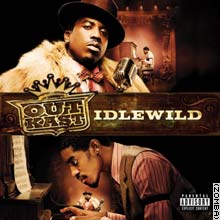
Idlewild

I got my hands on a leaked version review copy of Idlewild about two weeks ago and after repeated listening have nothing exactly laudatory to say. What’s worse is that I don’t think it’s any better than Speakerboxxx/The Love Below , which is a shame because I didn’t find that any better than Stankonia. Needless to say, Aquemini was the tops for me, and, sadly, Qutkast has generally fallen off since then. Or is it simply a divergence of creative vision between Dre and Big Boi?

From what I’ve read, Idlewild the motion picture is no different from their working relationship of late. While Dre and Big Boi appear together at beginning of the film, they pretty much share no screen time for the rest of Idlewild. The same goes for the soundtrack.


Dre continues his falsetto treacle as a poor soloist on his end of the disc with cringe inducing tracks like “Chronomentrophobia”, a patently silly mess, and “Greatest Show On Earth”, which features the raspy wheeze of Macy Gray introducing herself and then saying, right after, “I don’t give a damn”. It’s actually kind of funny. “Life is Like a Musical”, a tropically cloying synth-organ-ed jaunt, could’ve been longer.

As for Big Boi, the first single, “Morris Brown”, is a particularly affecting cymbal/bass/drum banger. And that hook is killer. August horns and a wistful chorus elevate “The Train”, Big Boi weaving a typically candid narrative. And yet as a synthesis Idlewild works far better than the partitioned sb/tlb, as well as containing stronger stand alone songs – no “Hey Ya!” here, but solid nonetheless.

But of course the track no one should sleep on is “Hollywood Divorce”, featuring Lil’ Wayne, Snoop, Dre, and Big Boi. Someone turned out the lights. Creepy ass organs sound off. An electronic snare, or what sounds like one, chops up the track awkwardly. Lil’ Wayne’s sixteen is solid and sleepy, while Dre and Big Boi eat up the track entirely. Snoop’s seems like an afterthought.

Sunday, August 13, 2006

Miami Vice


I went to see this a couple of weekends ago and was generally surprised at how well Michael Mann turned the Regan era decadence and gloss of the original into a darker, more filmic monster. To be sure, Mann is the maestro of cool when it comes to the drug/crime/underworld genre with films like Heat and more recently Collateral. The subjects of his films are always the most priapic, brooding men surrounded by all of the finest accouterments someone of their level of coolness would naturally have, or failing that, already integrated into the mythology machine of Cool. Ali and Heat are fine examples of this. To wit: Miami Vice is touched with the Mann imprimatur of coolness in a ways far more cinematic, if not experimentally challenging, than his earlier films. Visually, Miami Vice is jarringly dissonant while proving consistently engaging.

The opening club scene of Farrell and Foxx surveying a packed dance floor, a Jay-Z/Linkin Park mash-up punctuating the hard and tight shot changes, draws the viewer into the quieted of cacophony. It’s too easy to get lost in the jumble of situations such as these, but Farrell and Foxx cut through the crowd with an eerie stoicism to dispatch of some bad characters. Like the club scenes in Collateral an austere tone pervades the surface, nearly embedding itself into the content of the scene. The sound and disorder is the scene and everything else going on -- the breaking of hands, the knocking down of random people -- is simply the medium Mann pushes it through. It’s really difficult to follow, but somehow it all makes sense.

When Farrell and Foxx make their way to the rooftop of the club we get a panoramic cityscape of Miami, thunderbolts trembling and lighting flares igniting. Farrell and Foxx are placed at the bottom centre to bottom right of the shot, never truly its focal point. I want to say this was Mann being unintentional about ontology and simply being inured by the “great shot”, but I’d be hard pressed. I’d suggest that the shot’s ontology (and likely that of the film) is itself. It exist for itself and not the characters, hence the visual marginalization or de-emphasis of Farrell and Foxx. Another interesting aspect of the shot is the grainy patina of the high definition camera, which comes off as chintzy, so much so that it’s nearly boiled down to comic book storyboarding. Yet this is what also places the surrealism onto your lap, so to speak: one can’t help but feel either inside or outside this technical strategy’s conceit. My friend was not willing to commit this and so began rolling his eyes in anticipated exasperation. I, however, was following.

Farrell and Foxx are off to find a wayward friend now. An ingenious Viper camera slides overtop and beside other traffic while following their car. The high definition renders everything anxiously, evoking more a mood than a narrative. And this is the general problem people have with Miami Vice, that of the narrative being threadbare or virtually non-existent or, worse still, pointless. These, I take it, are backhanded compliments, in a way, since Mann is hardly working for a narrative, not in the least. To rehearse a police procedural of the likes of Miami Vice would be to revisit all of the torpid clichés and stock gimmicks we typically get from the police/crime procedurals. We saw Bad Boys 2, we know the deal. Mann, however, has supplied literally no back-story for either of his leads, Crocket and Tubbs, and portrayed their relationship, usually a jocular camaraderie, as distant but not cold.

What follows is an exercise in the inscrutable; we understand nothing deeper or more enlightening about the characters, their development or necessary trajectory leading us nowhere particularly interesting.

The mood is the subject. The mise en scene is the mood, and the characters and whatever paltry narrative is offered are not figures standing on top of the mise en scene but necessarily ground into it. I’m still attempting to unpack my thoughts on all of this, so excuse me if this sounds maddeningly obtuse. But my take is that Mann has created something very evocative and visceral here, something very akin to what Terrence Malick accomplished in The New World, a film that elicited a similarly appealing if not altogether perplexing set of emotional responses. I can say that I like both. And maybe like isn’t the right word. But I can say that both films were challenging, both intellectually and perceptually.

Not unrelatedly, I read a story of theaters in Japan spraying particular scents during particular scenes in a movie to heighten the realism, like grass when the scene is in a field. The olfactory sense allows the viewer to experience the film at another level. Something like this is going on in Miami Vice albeit at another, cognitively novel level. Sure it’s a movie you see – but it’s also one that you feel.

Thursday, July 06, 2006

China, Russia and the New World Order.


And therein lies the dilemma
. With all the hemming and hawing going on in American political circles (or perhaps it’s only the cable news outlets) there is nothing short of military intervention the United States can do to North Korea -- nothing they could have done during the first Bush Administration, nothing they could have done during Clinton’s eight years in office. The balance of power rests with China and Russia, and regardless of North Korea’s varied and often times paltry attempts at saber-rattling, the United States, even along with any support the EU can provide, isn’t in a position to do much. The UN is ineffectual in the sense that it’s always been the formal face of naked power politics.

During the cold war, the Security Council didn’t work, or was a joke. And while the Berlin Wall was being dissembled and the halcyon years of the 90’s were being ushered in, the unipolar world historian and political scientists anticipated already had a best before date. China and Russia have and will always be that counterweight to US hegemony; this is simply a fact of international relations.

That North Korea can act like they have, drawing worldwide rebuke, proving nothing but there military incompetence (the missiles failed during launch) and still draw no Security Council support for sanctions from neither Russia nor China speaks to the natural symmetry geopolitics necessarily assumes, or will eventually revert back to. All that talk about American Empire now seems woefully premature if not altogether silly.

Wednesday, June 07, 2006

Not Cool.

As quick as I am to disparage Stephen Harper and his Conservative government, as loath as I am to admit that he's doing some counterintuitvely interesting things (the play for the middle-class, enticing the immigrant vote, out-moderating the Liberals) I am clearly not in favor of beheading our Prime Minister -- not in an ironical sense, not in metaphorical sense, and likely not in a fictional sense (at least not now, since it'll likely be over-done).

And so the recent terror arrests still have me a little nonplussed; how exactly Canada is a credible target -- not that other nations are more deserving -- strikes me as absurd. But we are -- and if the allegations prove to be accurate, sensational as they are, it's an entirely different ballgame; and as much as we'd wish we weren't, Canadians are in the field of play.

Sunday, May 14, 2006

n+1


The newest issue of n+1, Reconstruction, arrived on Tuesday, and it’s a thick one. The Intellectual Scene column chronicling the piquant cultural ruminations of our hapless, misanthropic, and nameless narrator has been interrupted, apparently as a result of fact that "our culture and everyday life may not exist in their current form much longer." He will, if we are lucky, likely return for issue # five.

But the gauntlet has been dropped, and this interruption prefaces a piece by Chad Harbach on the ever-contentious and now au courant debates concerning the threat of Global Warming. That we have crossed the point at which reversal is no longer an option; that our technological capabilities and our capitalist market economies disregard both social and environmental externalities; that having escaped, if only for the time being, the threat of mutual nuclear destruction has afforded us a comfort only borne of complacence is essentially what Harbach’s getting at. And now with climate patterns varying wildly - floods, hurricanes, tornados, sun nearly every day in February (in Ontario) - the thought that it is not each other we should fear but, instead, mother nature's impending wrath or revenge, what have you, is the comeuppance we'll deserve.

Meanwhile, I haven't looked through the entire issue yet, deferring to read and savor it in portions, but it's turning out to be one of the more interesting issues. The flame war between critic James Wood and novelist Jonathan Franzen continues with a Franzen letter to the editors. Franzen is incredulous to Woods imputation that he practices a “Thin Aestheticism.”

The first salvo, if it could be called that, was Wood's review of Franzen's The Corrections for the New Republic. In it, Wood invoked Franzen's infamous Harper's essay, a lamentation on the diminishing possibility of the Social Novel, which he called "intelligent" and "affecting" but also "long" and incoherent. Of Franzen's solution, now having relented on the idea of a Social Novel altogether, Wood detected a "Thin Aestheticism" in Franzen’s tone; Franzen's tacit intention was now, as he saw it, "To write sentences of such authenticity that refuge can be taken in them."

And it was back in issue # three, Reality Principle, in which Wood was replying to the editors’ churlish assessment of the negative tendency literary criticism had taken, that Wood re-invoked Franzen's "Thin Aestheticism". Although, to be fair, he believed that Franzen couldn't really adhere to something of the sort. Franzen has taken exception to this by responding that he'd like to admire Wood but can't really trust him. At one level Franzen has misread Wood and Wood has misunderstood Franzen. Yet on another, they disagree on the means, though the constituent parts of a novel turn out to say something social nonetheless.

Further on in issue # four we get a trenchant survey of American Writing Today, of which Keith Gessen's essay on Money and publishing is a must read. On balance, the issue seems a strong one.

Monday, May 01, 2006

A day without irony


What universe do we live in when Daryn Kagan of CNN can say "It looks like a victory for the former stripper Anna Nicole Smith at the US-Supreme court" without a hint of irony? But hat-tip to ANS who is owed something in the order of $200 million dollars. That aphorism about there not being enough money in the world to buy class and whatnot may, in this instance, not obtain. Certainly one could buy a modicum of class or, at the very least, something resembling class with $200 million dollars.

Thursday, April 27, 2006

Non-sequiturs


Gerard Kennedy, former Ontario education miniter, is running for the Liberal leadership. His intention: "To make Canada the first international country in the world." Really? And I actually like this guy. He seems (or seemed) compentent, was doing yeoman's work re-conceptualizing Ontario's pitful education system, particularly the Secondary Schools. In general, he didn't strike me as the kind of person who'd say this type of non-sense. Maybe I'm misunderstanding him, but it wouldn't have hurt to be a little more clear.