Monday, August 20, 2007

Sound and Sounds


An aberration on Spoon’s “The Ghost of You Lingers” sounds like a nullity of sound, a tear threatening to void the entire song. A closeted piano cycle, with its tight and odd chord progression, is foregrounded by layered vocals of Brit Daniel’s as echo, apparition, and spurned. “If you were here/Would you calm me down/You settled this part” an affectless Daniel’s offers while a spectral Daniel’s croons “All the strangers in town/Would know if you were here”. “The sleep fled from my eyes” he explains, “And I, know that I need some.” Completing the thought: it’s sleep that Daniel’s needs, and likely a lot of it.

“Ghost” is a small song, slight on musical elements (the somewhat sinister eight-note piano cycle; the falsetto as echo) though sonically pregnant in landscape. That the continued piano cycle remains static closes off any possibility for release. The layered vocals give the effect of oppositional selves, the plaints of lost love and the blank immediacies of present self.

Recall is a form of reconstruction here, and Daniel’s “If” is a conditional for a new possibility. He wants to try again, but is clearly in no shape to do so. There is the hint of paranoia, “All the strangers in town/Would know if you were here”, followed by an admission of instability, “Would you ease my mind?” A shouted “Come on!” seems more forceful than entreating.

So it’s likely the lingering ghost that’s threatening to void the song. That aberration appears in the final third of the song, a jarring distortion so outside of structure as to seem otherworldly, which, it should follow, is the point. Its a grinding and warping sound that repeats itself four other times, trailing off with Daniel’s invocation of “lingers”. The ghost is clearly a reconstruction from memory and haunts Daniel’s deteriorating mind.

Though the song creates a universe of Daniel’s mind on the first few listens, particularized and distant, his plaints are universal: that lost love and its remainder, the often deluded phantoms of memory we’re left to communicate with and ultimately exorcise, will rend us before they are dealt with. Or, put another way, must rend us before they are dealt with.

Monday, May 14, 2007

Convergence


The Strawman officially turned three on April 18th, which is, in the fickleness and celerity of our current culture, not an insignificant accomplishment. Though, really, what is prideful in celebrating a blog, as dazzling as it is/was at times, left idle, sometimes for months, vacant and seemingly vanquished?

Well, if the absences were necessary and likely unavoidable; if the content produced lacked a certain amount of timeliness and topicality (not merely transcriptions of the apparently endless transcriptions of the apparently endless events, everywhere, that announce themselves as news and boast of their worthiness and therefore require, if not demand, our attention); if, importantly, there was a thoughtfulness and care to both the writing and the intellectual curiosity that provoked the writing (The Subject/The Occasion); and if, finally, it were not an imposition, a joyless task, merely an extension of the modern’s anxious busy work that evades peacefulness or solitude for want of excitement, for fear of loneliness, then pride can be found in small places.

I can admit, somewhat abashedly, that if the amount of writing on this blog, since its inception, has decreased, then, even if by small measures, the quality and interestingness of the content, and hopefully that of the writer, as well, has increased, or matured.

And yet, this blog’s initial mandate was to, as I recall, “pump out as much commentary as is humanly possible-- or at least until I run out of things to comment on”; and while that was a foolhardy scatological salvo into the blinds of the blogosphere, those were the heady and exuberant days when the transcription of the transcription wasn’t banal.

Indeed, in the three years that have elapsed there has been no shortage of available commentary, nearly all of it redundant. Why the commentary is all too available is obvious: the proliferation of New Media platforms (Blogs, Podcast, Vlogs, etc.) and the growing hegemony of content hosts as a means for this dissemination of comment (viz. You tube and Blogger, among others). The growth has been exponential, dizzying.

And while the commentary can neither be entirely discounted nor categorically merited, as a social phenomenon it is far too interesting and historically significant not to reckon with. En masse, a particular demographic from various industrialized countries (U.S, Canada, Europe, Japan) are externalizing thought. What would formally be considered diary entries, quiet ruminations for the writer’s own self-satisfaction (and likely for posterity) appear on the Internet as blog posts, a great number of which go unread.

To be sure, the fact that one’s work can go unread is one of the many appealing qualities of the blog. Additionally, the speed with which an errant thought on Thai cuisine or some effusive praise about The 40 Year Old Virgin or, likewise, a piercing meditation of Kant’s categorical imperatives can be put into writing, often ungrammatically (in both senses), and published online is head turning. The blog, it can be said, is impersonal and conversational in tone and operates on the contradictory assumption that it is both closed off from an audience and laid bear to the world; a diary. But diaries are written to be read, whether by the writer alone or the audience the writer imagines to be witnessing the act. Thus, much of the available comment, if its intentions are advertised or not, seeks some type of recognition.

+ + +

The push for human recognition, which finds its starting point in the Enlightenment with the individual’s autonomy from the monarch, and consequently the monarch’s separation from the state, placed individual liberty at the apex of political thought. Technology, for its part, has been nothing if not the extension of thought, an apparatus to realize in some efficient manner our mental desires and to relieve our material constraints. Scientific rationalism (the application of general science and technologies to the practical problems of modern daily life) and the individual’s political, and therefore private, autonomy have created the modern circumstances for an unprecedented new form of self-expression.

Though, naturally, the access to this form of self-expression is predicated on sociological and economic realities. Blogs are predominately written/accessed by the middleclass; their political and cultural sensibilities generally shape the normative landscape of the blogosphere. Much of the blogosphere is simply many, many over-loud opinions and comments that differ only in degree, but not in kind.

There are so many positions one can take about the Iraq War, and I’ve taken all of them. From pacifist, to Humanitarian interventionist, to the rouge Hawk, and finally, regrettably, to Apathy and Fatigue, the evolution has been a tiring one. The blogosphere, most particularly in its public affairs and political enclaves, requires a discipline of thought, of totalizing omni-reflective thought, both intellectually exhilarating and emotionally, and oftentimes physically, exhausting. One must have a position on everything. And quickly.

If journalism is the first draft of history, blogs are the notes, the kinetic sparks of history the Organism in movement. And no reliable or substantial critical analysis of society, of politics, of culture, can accommodate these demands, nor should it ever aspire to. Which is to say that, while the platforms for New Media are a considerably promising in the development of a participatory citizenship (albeit limited in accessibility), the attendant atmosphere of sound, fury, and celerity tends to be noxious to sober, unadorned thought.

Print publications like the New Yorker and The New Republic (Old Media) who publish long articles and essays are having to contend with the speed of the blogosphere. Going against conventional wisdom, The New Republic (recently purchased by Canadian media conglomerate CanWest) will now publish bi-weekly, on glossier paper, and double its content, which, in a time where speed carries more currency than thoughtful opinion, is welcomed.


+ + +

But isn’t this necessarily an excuse or rationalization for inactivity, for pointless navel gazing while crenels of the political and cultural events of our time pop furiously? Yes and No. The dynamism of New Media platforms greatly narrows the gap of event and coverage to near simultaneity. As quickly as it occurs, it is reported, chewed over, hastily contextualized and then re-contextualized. The media culture is ravenous, nearly cannibalistic, implicating all, consuming everything. An event is devoured and quickly excreted in almost light speed, never truly digested in the process.

This is where, I suspect, deliberative, dry analysis intercedes, to collect all of these undigested and indigestible parts of social material, as paleontologist do, and create an explicable if not entirely comprehensive narrative of the components, the players, and, often, the sheer randomness of past events. So, ultimately, it is not a zero-sum game where New Media will win simply by foot speed. Instead, Old and New media can act as adjuncts to each other while competing for the same audience and complimenting the desires of their readership.

Tuesday, May 08, 2007

On Faces: Facebook/False Intimacies


(Some preliminary and still gestating thoughts)

I hate social networking. Only after much scorn and derision and coercion did I relent and place a profile on Facebook. Naturally it was under a fake name with no picture and no likelihood of activity. Not so, it seems. It began with a little gravity, things pulling themselves to me, disparate pieces of a life left behind shifting orbit, coming closer. People I had no intention or desire to ever talk to again started "poking" me, importuning, insisting that we be "friends", again. And who could deny a classmate from elementary school, who's heart is so cold, so closed off? Who could begrudge us that innocence, that naivety, of secret hand shakes, ashen legs, red faces?

No one. Not then. We were young then. But now? What are we after? No one is denied; everyone must enter your life again, and enter with a crooked smile and false bonhomie, or you will pay with psychic dread. Am I a bad person? Is my network of friends inclusive enough? If she is on his list and I am on his list, will she understand why she can't be on my list? And then thought collapse on itself, to the subject: why am I not on his or her list? What is my worth?

And suddenly your social currency is only validated, or not, when you check your inbox, your mind doing revolutions, needlessly, about people you may or may not ever see again, physically. But they will haunt you each time you visit your page, their words will bleed through your wall, offering intimacies to strangers, to you. This person you went to Univeristy with; this person you meet through an organization; this person who knows this person you know; this person who knows far too much about you.

Anything pushed to its extreme winds up having its opposite effect. When at first you wanted everyone closer, just at your finger tips, just in case, just to type those easy wittcisms and then return to more important things--you are now bound. Either be online and not reply; be busy and not reply; or disappear entirely. This is not a community of fellow travlers; this is the tyrany of the group.

Monday, March 12, 2007

Like a Doctor?


This typifies how incredibly derelict I was in following the goings-on in Canadian political life during my long absence. It would be embarrassing had I not had a credible excuse. Even so, I actually remember watching the hearings, surprised like everyone else to witness Zaccardelli's pitiful evasions, evasions so patently without sincerity, so wincingly lawyerly, it seemed obvious to most that Zaccerdelli got talking points from the PMO. And it wasn't as though the Harper government had to worry about culpability; the entire Arar mess took place under the previous Liberal Government, which led many to suspect that the Conservative government was more interested in saving face and not appearing weak by having to firing Zaccardelli.

But the ignorance Zaccardelli claimed to the details of the Arar arrest, rendition, and detention was both comical and pathetic. And since he changed his orginal statement, it's difficult to determine whether or not he was simply protecting himself or the organizational hierarchy of the RCMP.

Nonetheless, that it took $25,000 in taxpayers monies (of which I will contribute nothing in the fiscal year of 2007) to prepare Zaccardelli for the parlimentary hearing seems a tad excessive, considering all he was required to do, as Liberal MP Sue Barnes notes, was "tell the truth to Canadians." The $25,000 fee for consultation went to Ottawa PR firm McLoughlin Media, whose only comment on the matter reads thusly:

We're a private company, and part of what we do is to never talk about the people that we may or may not have worked with. It's inappropriate. It's like being a lawyer or a doctor.

I wonder what that's like? Being like a lawyer or a doctor...

Friday, March 09, 2007

Japan Times


Tokyo Sushi - Osaka Roll
Originally uploaded by Jon ..
I moved to Japan. That was around five months ago. Not that anyone really visited this site in the first place, but I felt it somewhat necessary after such a long absence to, at the very least, post a few sentences. First, I was without Internet for a two-month period. This, naturally, was soul crushing. It was also an incredibly contemplative time. I didn’t even bother reading the English dailies, nor did I bother to follow the news through that ingenious piece of technology that is my cell phone. The Democrats took Congress; Dion won the Liberal Leadership; Saddam was hung; a rare, prehistoric shark with florescent eyes was spotted in the Japan Sea. Bits and pieces of the outside world sooner or later emanated toward me., unbidden, without my active effort.

I began learning Japanese, to which, at this point, I can claim no mastery. I traveled. I read. I stood still. I did battle with Onsen . I lost spectacularly, each time resolving to begin again. And I did. And so I will.

Tuesday, September 19, 2006

High on Sorkin


We here at the Strawman love, love Aaron Sorkin. We love his wit, his assured charm, his facility with the spoken and written word, and, not least, his overall bravura. The guy’s got chops. If we didn’t love the entirety of A Few Good Men (adapted from his Broadway play) we certainly loved that testy verbal exchange between Tom Cruise and Jack Nicholson near the end. You remember, “I want the Truth”; “You Can Handle the Truth”. (Actually, that’s rather topical with respect to the whole definition of torture debate going on. But anyway)

And let us not forget our love for West Wing, that White House Drama about the political machinations and fascinating personalities at the highest level of government. We remember downloading all of the episodes we missed, watching them more than twice, if only to follow the oftentimes hurried and inscrutable dialogue. We were sad to see it go off the air, but not surprised. We barely watched the last two seasons. And when Leo (John Spencer) died, well, what was left to say? President Bartlet was succeeded by President-Elect Santos -- both democrats, as fanciful as that was. But the show’s decline began when its writer and creator, Aaron Sorkin, was fired two seasons prior. And of course, he needed a Job, so he went to Hollywood.

Studio 60 on the Sunset Strip is Sorkin’s new job, and he’s brought along Bradley Whitford from the West Wing. The show revolves around the behind-the-scene travails of a Saturday Night Live type production where Whitford and Mathew Perry (of Friends fame) are tasked to helm writing and directing responsibilities. Perry, the writer, has an addiction (or will likely develop one) to painkillers. Both Sorkin and Perry have had histories of drug addiction, so the casting is both self-referentially smirking at us, and so Meta as to be absurd. The charcters were already unbelieveable to begin with, and even more so now. Moreover, it’s self-flattery of the most cringe-inducing sort that Perry’s character is a brilliant award-wining writer, formerly of the NBS network, from where he was fired three years prior, only to be asked back to the network.

Everything about S60SS is self important and bloated, much like the West Wing. The only difference between two, however, is that the bloat and self-importance was necessary for the subject matter of the West Wing, whereas S60SS feels incredibly self-satisfied, not to mention self-masturbatory. When you write about politics at the highest level, seriousness, vapid moralizing, and false, if bien-pensantt, equivalencies are what one traffics in without regard to accuracy. The source material is the White House. But when its Hollywood, and it’s about a “comedy show” and the guys who run it—pah-leas. Which is to say I found nothing particularly compelling about S60SS, nor was any of Sorkin’s script for the pilot the least bit memorable. Needless to say, I didn’t like, and now await its inevitable cancellation.

Sunday, September 17, 2006

Mea without the Culpa


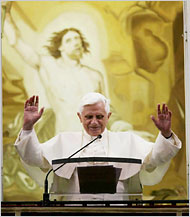
After some infelicitous words about Mohammed's teachings and their broader implications on the essence of Islam, namely that they resulted in “evil” and “inhuman” things, the Pope is backtracking. Sort of:

“At this time I wish also to add that I am deeply sorry for the reactions in some countries to a few passages of my address at the University of Regensburg, which were considered offensive to the sensibility of Muslims”

Right. Obviously the emphasis is mine. The Pope’s non-apology turns on rhetorically self-protecting phrases like being deeply sorry “for the reactions”, but not for the actual remarks which, of course, he had the right, and good sense, not to make. Also, that he thinks his remarks “were considered offensive” regardless of whether or not “he” considered them offensive (where he remains silent) elides responsibility again. Although, if he truly believed they were offensive it’s unlikely he would've made them in the first place.

But in the Pope’s defense, the remarks he made where quoted from a medieval text, from which he took the caution to explicitly attribute (“and I quote” etc.) And yet that seems to confound the Pope's conduct, since it must have been clearly obvious to him the incendiary nature of his remarks and the likely response.

Friday, August 25, 2006

Idlewild

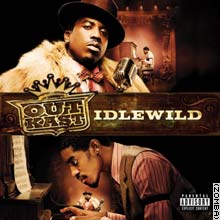
I got my hands on a leaked version review copy of Idlewild about two weeks ago and after repeated listening have nothing exactly laudatory to say. What’s worse is that I don’t think it’s any better than Speakerboxxx/The Love Below , which is a shame because I didn’t find that any better than Stankonia. Needless to say, Aquemini was the tops for me, and, sadly, Qutkast has generally fallen off since then. Or is it simply a divergence of creative vision between Dre and Big Boi?

From what I’ve read, Idlewild the motion picture is no different from their working relationship of late. While Dre and Big Boi appear together at beginning of the film, they pretty much share no screen time for the rest of Idlewild. The same goes for the soundtrack.


Dre continues his falsetto treacle as a poor soloist on his end of the disc with cringe inducing tracks like “Chronomentrophobia”, a patently silly mess, and “Greatest Show On Earth”, which features the raspy wheeze of Macy Gray introducing herself and then saying, right after, “I don’t give a damn”. It’s actually kind of funny. “Life is Like a Musical”, a tropically cloying synth-organ-ed jaunt, could’ve been longer.

As for Big Boi, the first single, “Morris Brown”, is a particularly affecting cymbal/bass/drum banger. And that hook is killer. August horns and a wistful chorus elevate “The Train”, Big Boi weaving a typically candid narrative. And yet as a synthesis Idlewild works far better than the partitioned sb/tlb, as well as containing stronger stand alone songs – no “Hey Ya!” here, but solid nonetheless.

But of course the track no one should sleep on is “Hollywood Divorce”, featuring Lil’ Wayne, Snoop, Dre, and Big Boi. Someone turned out the lights. Creepy ass organs sound off. An electronic snare, or what sounds like one, chops up the track awkwardly. Lil’ Wayne’s sixteen is solid and sleepy, while Dre and Big Boi eat up the track entirely. Snoop’s seems like an afterthought.

Sunday, August 13, 2006

Miami Vice


I went to see this a couple of weekends ago and was generally surprised at how well Michael Mann turned the Regan era decadence and gloss of the original into a darker, more filmic monster. To be sure, Mann is the maestro of cool when it comes to the drug/crime/underworld genre with films like Heat and more recently Collateral. The subjects of his films are always the most priapic, brooding men surrounded by all of the finest accouterments someone of their level of coolness would naturally have, or failing that, already integrated into the mythology machine of Cool. Ali and Heat are fine examples of this. To wit: Miami Vice is touched with the Mann imprimatur of coolness in a ways far more cinematic, if not experimentally challenging, than his earlier films. Visually, Miami Vice is jarringly dissonant while proving consistently engaging.

The opening club scene of Farrell and Foxx surveying a packed dance floor, a Jay-Z/Linkin Park mash-up punctuating the hard and tight shot changes, draws the viewer into the quieted of cacophony. It’s too easy to get lost in the jumble of situations such as these, but Farrell and Foxx cut through the crowd with an eerie stoicism to dispatch of some bad characters. Like the club scenes in Collateral an austere tone pervades the surface, nearly embedding itself into the content of the scene. The sound and disorder is the scene and everything else going on -- the breaking of hands, the knocking down of random people -- is simply the medium Mann pushes it through. It’s really difficult to follow, but somehow it all makes sense.

When Farrell and Foxx make their way to the rooftop of the club we get a panoramic cityscape of Miami, thunderbolts trembling and lighting flares igniting. Farrell and Foxx are placed at the bottom centre to bottom right of the shot, never truly its focal point. I want to say this was Mann being unintentional about ontology and simply being inured by the “great shot”, but I’d be hard pressed. I’d suggest that the shot’s ontology (and likely that of the film) is itself. It exist for itself and not the characters, hence the visual marginalization or de-emphasis of Farrell and Foxx. Another interesting aspect of the shot is the grainy patina of the high definition camera, which comes off as chintzy, so much so that it’s nearly boiled down to comic book storyboarding. Yet this is what also places the surrealism onto your lap, so to speak: one can’t help but feel either inside or outside this technical strategy’s conceit. My friend was not willing to commit this and so began rolling his eyes in anticipated exasperation. I, however, was following.

Farrell and Foxx are off to find a wayward friend now. An ingenious Viper camera slides overtop and beside other traffic while following their car. The high definition renders everything anxiously, evoking more a mood than a narrative. And this is the general problem people have with Miami Vice, that of the narrative being threadbare or virtually non-existent or, worse still, pointless. These, I take it, are backhanded compliments, in a way, since Mann is hardly working for a narrative, not in the least. To rehearse a police procedural of the likes of Miami Vice would be to revisit all of the torpid clichés and stock gimmicks we typically get from the police/crime procedurals. We saw Bad Boys 2, we know the deal. Mann, however, has supplied literally no back-story for either of his leads, Crocket and Tubbs, and portrayed their relationship, usually a jocular camaraderie, as distant but not cold.

What follows is an exercise in the inscrutable; we understand nothing deeper or more enlightening about the characters, their development or necessary trajectory leading us nowhere particularly interesting.

The mood is the subject. The mise en scene is the mood, and the characters and whatever paltry narrative is offered are not figures standing on top of the mise en scene but necessarily ground into it. I’m still attempting to unpack my thoughts on all of this, so excuse me if this sounds maddeningly obtuse. But my take is that Mann has created something very evocative and visceral here, something very akin to what Terrence Malick accomplished in The New World, a film that elicited a similarly appealing if not altogether perplexing set of emotional responses. I can say that I like both. And maybe like isn’t the right word. But I can say that both films were challenging, both intellectually and perceptually.

Not unrelatedly, I read a story of theaters in Japan spraying particular scents during particular scenes in a movie to heighten the realism, like grass when the scene is in a field. The olfactory sense allows the viewer to experience the film at another level. Something like this is going on in Miami Vice albeit at another, cognitively novel level. Sure it’s a movie you see – but it’s also one that you feel.

Thursday, July 06, 2006

China, Russia and the New World Order.


And therein lies the dilemma
. With all the hemming and hawing going on in American political circles (or perhaps it’s only the cable news outlets) there is nothing short of military intervention the United States can do to North Korea -- nothing they could have done during the first Bush Administration, nothing they could have done during Clinton’s eight years in office. The balance of power rests with China and Russia, and regardless of North Korea’s varied and often times paltry attempts at saber-rattling, the United States, even along with any support the EU can provide, isn’t in a position to do much. The UN is ineffectual in the sense that it’s always been the formal face of naked power politics.

During the cold war, the Security Council didn’t work, or was a joke. And while the Berlin Wall was being dissembled and the halcyon years of the 90’s were being ushered in, the unipolar world historian and political scientists anticipated already had a best before date. China and Russia have and will always be that counterweight to US hegemony; this is simply a fact of international relations.

That North Korea can act like they have, drawing worldwide rebuke, proving nothing but there military incompetence (the missiles failed during launch) and still draw no Security Council support for sanctions from neither Russia nor China speaks to the natural symmetry geopolitics necessarily assumes, or will eventually revert back to. All that talk about American Empire now seems woefully premature if not altogether silly.

Wednesday, June 07, 2006

Not Cool.

As quick as I am to disparage Stephen Harper and his Conservative government, as loath as I am to admit that he's doing some counterintuitvely interesting things (the play for the middle-class, enticing the immigrant vote, out-moderating the Liberals) I am clearly not in favor of beheading our Prime Minister -- not in an ironical sense, not in metaphorical sense, and likely not in a fictional sense (at least not now, since it'll likely be over-done).

And so the recent terror arrests still have me a little nonplussed; how exactly Canada is a credible target -- not that other nations are more deserving -- strikes me as absurd. But we are -- and if the allegations prove to be accurate, sensational as they are, it's an entirely different ballgame; and as much as we'd wish we weren't, Canadians are in the field of play.

Sunday, May 14, 2006

n+1


The newest issue of n+1, Reconstruction, arrived on Tuesday, and it’s a thick one. The Intellectual Scene column chronicling the piquant cultural ruminations of our hapless, misanthropic, and nameless narrator has been interrupted, apparently as a result of fact that "our culture and everyday life may not exist in their current form much longer." He will, if we are lucky, likely return for issue # five.

But the gauntlet has been dropped, and this interruption prefaces a piece by Chad Harbach on the ever-contentious and now au courant debates concerning the threat of Global Warming. That we have crossed the point at which reversal is no longer an option; that our technological capabilities and our capitalist market economies disregard both social and environmental externalities; that having escaped, if only for the time being, the threat of mutual nuclear destruction has afforded us a comfort only borne of complacence is essentially what Harbach’s getting at. And now with climate patterns varying wildly - floods, hurricanes, tornados, sun nearly every day in February (in Ontario) - the thought that it is not each other we should fear but, instead, mother nature's impending wrath or revenge, what have you, is the comeuppance we'll deserve.

Meanwhile, I haven't looked through the entire issue yet, deferring to read and savor it in portions, but it's turning out to be one of the more interesting issues. The flame war between critic James Wood and novelist Jonathan Franzen continues with a Franzen letter to the editors. Franzen is incredulous to Woods imputation that he practices a “Thin Aestheticism.”

The first salvo, if it could be called that, was Wood's review of Franzen's The Corrections for the New Republic. In it, Wood invoked Franzen's infamous Harper's essay, a lamentation on the diminishing possibility of the Social Novel, which he called "intelligent" and "affecting" but also "long" and incoherent. Of Franzen's solution, now having relented on the idea of a Social Novel altogether, Wood detected a "Thin Aestheticism" in Franzen’s tone; Franzen's tacit intention was now, as he saw it, "To write sentences of such authenticity that refuge can be taken in them."

And it was back in issue # three, Reality Principle, in which Wood was replying to the editors’ churlish assessment of the negative tendency literary criticism had taken, that Wood re-invoked Franzen's "Thin Aestheticism". Although, to be fair, he believed that Franzen couldn't really adhere to something of the sort. Franzen has taken exception to this by responding that he'd like to admire Wood but can't really trust him. At one level Franzen has misread Wood and Wood has misunderstood Franzen. Yet on another, they disagree on the means, though the constituent parts of a novel turn out to say something social nonetheless.

Further on in issue # four we get a trenchant survey of American Writing Today, of which Keith Gessen's essay on Money and publishing is a must read. On balance, the issue seems a strong one.

Monday, May 01, 2006

A day without irony


What universe do we live in when Daryn Kagan of CNN can say "It looks like a victory for the former stripper Anna Nicole Smith at the US-Supreme court" without a hint of irony? But hat-tip to ANS who is owed something in the order of $200 million dollars. That aphorism about there not being enough money in the world to buy class and whatnot may, in this instance, not obtain. Certainly one could buy a modicum of class or, at the very least, something resembling class with $200 million dollars.

Thursday, April 27, 2006

Non-sequiturs


Gerard Kennedy, former Ontario education miniter, is running for the Liberal leadership. His intention: "To make Canada the first international country in the world." Really? And I actually like this guy. He seems (or seemed) compentent, was doing yeoman's work re-conceptualizing Ontario's pitful education system, particularly the Secondary Schools. In general, he didn't strike me as the kind of person who'd say this type of non-sense. Maybe I'm misunderstanding him, but it wouldn't have hurt to be a little more clear.

Monday, April 24, 2006

The Guggenheim


Last week at around this time I was making my way through Frank Lloyd Wright's architectural lodestar, the Solomon R. Guggenheim Museum in New York. Only after scrutinizing as many pieces of David Smith's contorted steel sculpture as was humanly possible in two hours, I realized that a Wassily Kandinsky exhibit was also showing and, fortuitously, stumbled into the right room.

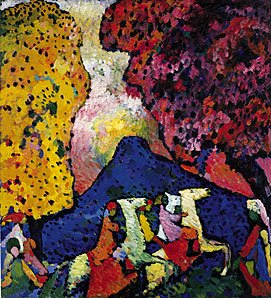
And I can't say that I'm too much of a fan. There seems to be a saccharine quality to Kandinsky's work, an overwhelming surfeit of color that can induce nausea. His geometric work, which is generally considered his later work, strikes me as more interesting. And yet.


Blue Mountains, Kandinsky


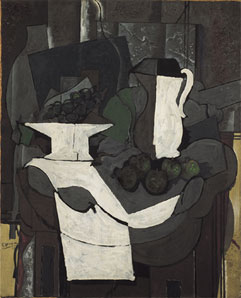
Little did I know that the Museum's permanent collection, the Thannhauser collection, was available for viewing and not in the vault as I suspected -- whereas some Museums think it wise to place their Warhols and Hockneys, their only draws no doubt, in the vault. So I got to see some Cubists, Braque and Picasso, and some Impressionists, Manet, Passario, Monet (whose work I didn't get to see at the Louvre); and two unlikely corresponding contemporaries, Gauguin and Van Gogh; and a slew of contemporary art: de Kooning, Pollack, Stella, Kline, Gottlieb, Rothko, if they could be considered contemporary in any proper sense.

The Bowl of Grapes, Braque


Since I had to go back to Connecticut that night, I didn't get a chance to get to MoMA, spending most of my time either wandering around Central Park or trying to catch celebs on 5th or Central Park West.

Friday, April 14, 2006

cadenceweapon

I'm literally out the door on my way to Connecticut, so I'll dispense with all the formalities. I'll comment later on the CYHSY show at the Oprea House last weekend (Crazy!) and the Ralston Saul Lecture at Western (Yawn). But I can't seem to get this ridiculous (as in good) song out of my head,here.

Friday, March 24, 2006

Betwixt and Between

The Great Game has begun again in an entirely different context. This time, instead of Central Asia it’s Eastern Europe, predominantly Orthodox Christian countries. And instead of Britain (essentially the EU countries) it’s the United States facing off against Russia in a stealth game of geopolitical proxy chicken. No military engagement seems necessary; rather, it’s the ineluctable march of democracy that appears to be driving these successive revolutions. First, the Rose Revolution in Georgia, technically in Central Asia, but a former Soviet republic nonetheless, and then the Orange Revolution in the Ukraine, another former soviet republic, followed by what will be the Belarusian revolution, another breakaway Soviet republic.

This is an unwelcome development for Russia, who, even after the end of the Cold war, has always maintained a de facto regional sway over these republics, favoring and propping up Moscow friendly strongmen like Eduard Shevardnadze in Georgia, Viktor Yanukovych in the Ukraine, and now Alexander Lukashenko in Belarus. It is almost certain that Lukashenko will share the same fate of both Shevardnadze and Yanukovych, considering the circumstances are exactly the same. In the Georgian and Ukrainian contretemps, election results that were widely regarded as fraudulent resulted in civil unrest, which lead to international opprobrium and calls for either new elections, with credible international monitors of course, the path the Ukraine took, or the dissolution of government entirely, the way that Georgia went. And it’s obvious who benefited.

Mikhail Saakashvili, a graduate of Columbia Law School in the U.S and now president of Georgia, and Viktor Yushchenko, president of Ukraine, are pro-western, or more clearly, leaders of a neo-liberal bent. They are seen as integral pieces in wresting the reins of regional power from Russia. And although the United States and to a lesser extent the EU have no direct involvement in these developments (it may be patently obvious though) they have myriad indirect associations – because, in the end, it’s beneficial for them.

For instance, George Soros’ Open Society and the Liberty Institute, among numerous others, are private foundations that aim to shape international public and social policy, putatively, but are instead proxies that help foment civil protest against authoritarian governments, or primarily Eastern European governments, the type of concerted and behind-the-scenes actions that spelt the end of the Cold War. But is this a necessarily bad thing?

I’m always skeptical of arguments that discount the intentions of Georgians and Ukrainians' desire to have more transparent, less authoritarian government. Does a little push along hurt matters? Granted, the type of government that takes form after said ‘push along’ is where the issue turns. Would they be encouraged (forced) to remove all import tariffs, open up financial markets, sell off national resources at fire-sale prices, Privatize! Privatize! Privatize! and generally prostrate themselves to be a (subordinate) friend of the West?

This is a legitimate concern, one that can be countered by citing the experience of the Ukraine presently. It’s seems that just two years after the Orange revolution Viktor Yushchenko is having some trouble implementing his neo-liberal agenda, add that to the economic slow down in the region, and Mr. Yushchenko may lose the upcoming parliamentary elections. The answer, then, to neo-liberal hegemony, particularly in this case, seems to be the electorate’s desire for representative democracy and accountable government, a novel and historically well-tested concept the apathetic West should consider revisiting

And the two seemingly unrelated stories I came across today begin to cohere: The first, the US joining the EU in sanctions against Belarus president Alexander Lukashenko following, you guessed it, questionable election results; The second, more ominous, the Pentagon releasing a report that claims the Russian Foreign Ambassador in Iraq (sounds redundant) provided military intelligence to Saddam during the weeks preceding the US lead invasion, or war. That’s a twofer: one a slap on the wrist against Belarus, and by extension Russia, the other a direct shot square in the nose. But how will Russia counter? The Great Game continues.

Monday, March 13, 2006

Special Ops

Hat tip to Prime Minister Stephen Harper for visiting our Canadian troops in Kandahar, Afghanistan. Yes it looks like a cynical photo-op, and yes all those “mission accomplished” analogies can be raised; but because of the recent spat of intense attacks our soldiers have been under, this visit was both a morale booster and a politically astute move, considering the icy relationship between Mr. Harper and the media.

And yet on another level it begs for an actual public dialogue on Canada’s role in Afghanistan, something the Conservatives have thus far been unwilling to allow in Parliament. If Mr. Harper believes it was important to visit the troops, then it should follow that a public debate on their mission, if only to affirm its significance, should be convened in the house. Mr. Harper's trip only make this more likely, and attempts to rule out one only makes his jaunt to Afganistan that much more superficial.

Wednesday, March 08, 2006

Moving on

My apologizes to Mr. Haggis for my earlier vitriol against his, still undeserved, Best Picture win. Although it may appear to be the case, my protestations toward Crash having nothing to do with closeted homosexual sentiments and/or proclivities. And this is not to say that Brokeback Mountain isn’t at the political vanguard in normalizing the depiction of gay romance, which it is, but that it’s more than that: It’s really beautiful filmmaking; probably the best in some years, in my opinion. (OK, I’ll watch Junebug and Cache and then contextualize my praise for Brokeback.)

But the issue I have with Crash, along with many other dissenters, is how patently absurd it is. It’s flat out bad filmmaking, which makes all of this dissent revolve around aesthetics or form, even if the content is similarly hackneyed. Altmanesque ensemble cast: check. Conveniently interconnected narratives: check. Self-importance cudgel: check. Subtly: not check. I’d be rehearsing a number of points I’ve read in other places if I continue, points that were better elaborated and far sharper, so suffice it to say that Crash is a bad, bad, bad film. I can’t fight it, so I’ll just move on.

Monday, March 06, 2006

Against Crash, or why the Oscars are irrelevant

I’m calling bullshit on the Academy giving Crash the Oscar for Best Picture. Crash is an incredible film in the sense that real people don’t have conservations the way Crash has depicted them. Real people have psychological motives and a modicum of manners and better things to do with their time than blurt-out silly and unprovoked racial epithets. Despite its stirring second act, in which deus ex machinas abound to conveniently resolve all of the implausible if otherwise charming narratives, Crash is still a garbage film penned by a sentimentally manipulative hack (see Million Dollar Baby) It was obvious as the err occurred, Jack Nicholson opening the envelope, calling the wrong name: “Crash?”

There was a collective gasp which I’m sure Ang Lee, after receiving the Oscar for Best Director and being quickly shuttled off stage, registered. They didn’t cut to a shot of Heath Ledger or Jake Gyllenhaal or any one else in building but the cast of Crash and their hack of a director Paul Haggis. Yes, they wanted to capture the winners. But guess what – nobody else was smiling.

And if you think that Crash was some type of commentary on contemporary race relations, and that it somehow addressed our messy polarities – what we say to ourselves and how we act with others – then you are exactly the type of useful idiot who’d bite.

Crash
isn’t any of these things and is far less ambitious in its reach than the charlatan down the street or that clown at your office claims. It neither answers questions nor raises them. It’s an awful film. I hate it more now that it has won an Oscar. And this is tokenism of the highest order: to prop up a film as a lode star for a dialogue on race – a film that is criminally inane, a film that is thus charged with negligence for the harm that it will no doubt inflict.

So go forth and talk amongst your friends and family about how Crash changed your life. Tell your children about how Crash dealt with real people talking about race frankly. And it’s surely fitting that Haggis quoted Brecht, saying that “Art isn’t a Mirror, it’s a Hammer” which I guess is supposed to shape society.

Listen to Haggis’s admission: he’s not interested in reflecting society, since he couldn’t care less how real people talk to each other about race. And I’m not understating how he’s shaping it. Bertolt Brecht was overtly political in his drama; Paul Haggis is a hack. For a film purportedly interested in society and race, Crash isn’t political in any regard.