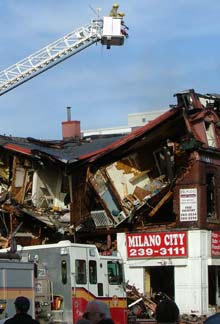
I live in a peculiar place. First, I should say, I live in Ottawa—not necessarily peculiar in any way except for the fact that the Federal legislature can be found here; or, in more
Canadianese, National parliament. On occasion, I’ve been lead to believe that I live
in downtown Ottawa when, instead, I actually live
close to downtown Ottawa. This is a difference without a distinction: I live close enough to Metcalf to throw rocks at, and maybe hit, the Ottawa Congress Centre. What am I trying to get at, exactly? Good question— I’m glad you asked.
Where I’m located is, as I joked to my roommate once, “A soci-economic fault line; the margins or, better still, the vortex through which any number of social realties tear apart as a result of the sheer centrifugal force of Gentrification.” I didn’t put it this long-windedly to him—but I should be forgiven: this is print.
Gentrification is the process by which a previously economically depressed area becomes economically viable. This is done, obviously, by the acquisition and re-development of once dilapidated and condemned real estate. I remember
seeing this happening in areas of downtown Detroit, where canny developers scooped up generous lots of real estate for below, as in subterranean below, market value—in some cases only $1000 for obscene amounts square-footage.
Back to Ottawa: as I was saying, the peculiarity of my area is similar. Gentrification is happening; but first, some context. (Imagine me standing outside, in front of my place. It will help.)
If I were to walk two blocks to the south, I’d find myself in a thriving, dissolute environment, replete with prostitutes, drug dealers, and social dependents —I want to say criminals, too, although I can’t say this positively. As if this shouldn’t be odd enough, If I were to go one block east from my digs—and this is being overstated; maybe it’s eleven strides, if that—I’d be overcome by the site of large Victorian homes, functional yet generic townhouse duplexes, and neatly modern, but faux, Brownstones(right down to the red sandstone). I have now entered family living and young-professional territory, where, I could imagine, neighbor visits neighbor, commenting on how white their cashmere sweaters are—I joke.
Going further east through this areas, one will come upon Bank Street, a main street in Ottawa that is populated, to the south mostly, by posh boutiques, excellent used book stores, rare specialty food shops, urbane pubs, and nearly too many Café and Coffee houses. This area is lovingly dubbed
The Glebe. The area becomes
Hyde Park Ottawa fast, as one quickly notices various embassies and luxury cars with inarticulate names. The Glebe is not Rockcliffe or Rosedale, clearly; but it’s not Bronson or Somerset, either. This is fully evolved affluence styling itself as bohemian cosmopolitanism. This is where gentrification emanates—flowing down Bank and Bronson, expanding Glebe proper.
Back to me, and now two blocks to the west: a lower and working class Italian neighbor, the jewel of which is Preston Street, spills forth with cultural verve and gastronomical draws—my favorite,
De Rienzo’s: Italian sandwiches
par excellence. Two blocks to the north, and running perpendicular to Preston, is Somerset, an upper-wardly mobile Chinese community assiduously trying to shed its working class roots, or so it seems.
So where do I live, in a descriptive sense, you ask? On the fault line: all the cultural and economic threads I’ve, heretofore, noted create the pastiches I live in. Social dependents, nuclear-family homes, extended Italian families, young professionals, and needlessly wordy students all call where I live home -- for the time being, that is.
As for gentrification, upscale condominiums are materializing, north and south, on Bronson, which will likely invite boutique shops that cater to them. Doubtless this will appreciate real estate prices in the surrounding areas, leading to increased rates of property taxation. If you’re a home owner, this isn’t necessarily a bad thing. But if you aren’t, it will mean increases in rent—increases that generally move quicker than relative increases in income. The amount of one’s income relative to the amount they pay for housing will predicate who moves first. The exodus will be composed of large families, lower income earners, and social dependants moving to more affordable housing, in the suburbs, one hopes.
I’m not entirely convinced this may be the case. With power centers, attractive swaths of property, and relative seclusion, suburban homes aren’t exactly inexpensive. Moreover, mobility and the dearth of available labour is another drawback. I’m unaware of a striving suburban constituency that is moderately affordable to live in and flush with available employment. Especially with fizzle of the technology markets, castrating nearly 16,000 jobs from Ottawa and leaving barren Silicon Valley North -- places like Stittville particularly -- this constituency seems elusive. As a consequence, people are staring to move further to the margins; Gatineau, Quebec, for example. Here rent is rock bottom and mobility into the city is tolerable.
Luckily, I’ll be out of the country before this comes to pass.
And as for solutions: I can’t say that I have any. These are some extremely powerful forces that, while moving imperceptibly slow, manifest as immovable realties almost instantaneously. I think this is a matter of logic, economics, and comparative social spheres, the separation of which confuses our understanding of the relevant issues—treating what is actual as though it were necessary.
The economics of gentrification are necessary because we say they are, and its logic appealing because we’ve begged the question: Economic flourish and viability is good; therefore, gentrification, the economic flourish of a previously depressed area, is good, if not better, and therefore necessary. But the logic is problematic for reasons dealing with what exactly good is, and to whom this good is generally directed. This, it must be understood, necessitates the analysis of comparative social spheres in the context and process of gentrification. Not only that, the conclusions and outcomes flowing from gentrification should be assessed comprehensively. The tautology that gentrification creates economic viability full stop and without deeper analysis will not do. I will stop now.