Ok, maybe this month of May hasn't been as unusually hot or warm as I had suggested in an earlier post. The last two days have been unseasonable chilly --down right cold -- despite it being generally sunny. But the political wrangling hasn't cooled down. Another day—another sanctimonious demand for the Liberal’s to step down and call an election.
The Bloc and Conservatives, again, pushed through and passed a motion to adjourn the house, bringing to a halt any house proceedings of substance or action. It becomes farcical when an opposition, in anticipation to a confidence vote they’ll likely not defeat (the Liberal Budget), stymie any convincible government work. Although most work is done within the “committees”, think it unlikely that anything of consequences is being accomplished.
In an interesting aside, Stephen Harpers thinks it's "shameful... disgusting and disgraceful" that the Liberals are holding their budget vote a day after Darrel Stinson's -- Conservative MP from British Columbia -- cancer surgery (queue the violins) . But to the rescue is our perpetual social conscience, the NDP: Ed Broadbent has suggested, and the Conservatives have duly accepted, that a member from his party not participate in the May 19th vote out of fairness.
I’m still steadfast to my earlier assessment that the Liberal budget will pass. However, I think it may be misconceived for two reasons. First, I grossly underestimated the organizational union the Conservative and Bloc have entered into. It’s not an unfair trope to say that the ‘Conservatives are sleeping with the Separatists’. (They clearly are, and why shouldn’t they? They have nothing to be ashamed of; both the Conservatives and the Bloc have at least one thing in common—they both hate Canada. I should, to be fair, put the point finer, and less infelicitously: they both hate, or strongly dislike, the federal government. The Bloc wants Quebec out of Canada, this much is obvious; while the Conservatives want the federal government, already seen as considerably diffuse in its centralized powers, shrunk down to the size of a pin head, leaving provinces to transact business between each other – without, of course, the invasive hands of the federal government in the way.)
Second, they seem to be really, really serious. The Conservatives and Bloc are frothing at the mouth. It’s time to put this rabid dog down.
Friday, May 13, 2005


Wednesday, May 11, 2005
The government won't fall...
On Thursday May 19 Parliament will be tasked to vote on the Liberals proposed budget bill. If it is voted down, Canadians are back to the polls—again; and only 10 months after the last election. As the heat and humidity rise in this unusually hot month of May, so does the political rancor and vituperative rhetoric. The Conservatives and Bloc are affecting all the right histrionics of the politically indignant, anxious to defeat the visibly damaged Liberals.
This is only made worse by the daily revelations of further and more troubling Liberal misdeeds coming out of the Gomery Inquiry. Meanwhile, the NDP, our country’s erstwhile marginalized social conscience, is doing what it can to help buttress the Liberals seat total, against that of Bloc and Conservatives combined. Some suggest that by acceding to a few of the particulars in the Liberals re-amended budget – the delaying of the corporate tax-cuts being one; which were initially taken out of the budget as per Jack Layton’s request – the NDP are playing useful idiots to Liberal hegemony.
I, on the other hand, see this differently. Before Jack Layton, in Stephen Harper’s words, made a deal with the devil, the Liberal budget allotted only $10 million for student loans and student debt relief, and $250 for social housing and miscellaneous social project. Those numbers, respectively, jumped to $150 million and $1 billion after Layton’s Faustian bargain.
I like that math.
But still, a push is being made for an election call even before the Liberal’s budget bill can be voted on. The Liberals lost a putative non-confidence vote yesterday – a procedural motion emanating from the public accounts committee – resulting in Conservative and Bloc demands that they step down and call an election immediately.
Immediately… Immediately?
As matter of form, constitutional convention dictates that a government only falls on a loss of confidence from a vote by a majority of the house—when this vote deals specifically with a money bill. The precedent here is the Mackenzie King government resigning after a motion of non-confidence that was unrelated to a money bill. However, since then, money bills -- the budget specifically – are considered the only legitimate confidence votes.
So why aren’t Bloc and Conservatives willing to wait for a legitimate confidence vote, like next week’s budget?
One reason: the budget will pass. And here’s why. During the last month the Liberal government has scattered the seeds of its success all throughout the country: $3 billion dollars to the Provincial government in Ontario, $338 million to British Columbia, child care monies for various Canadian municipalities, redistribution of the gas-tax to the cities, %100 royalties from offshore drilling to the eastern provinces. The Liberal government will not fall for all of these reasons and much more.
The Bloc and Conservatives know this. In fact, though the deciding vote will come down to the speaker of the house – Milliken, a Liberal – count on a number of Bloc MP’s to support the Liberal budget; a budget that is so incredibly socially progressive that it would hurt their constituency cred if they voted otherwise. So this is my prediction—the vote will be 155-150 for the Liberal budget.
This is only made worse by the daily revelations of further and more troubling Liberal misdeeds coming out of the Gomery Inquiry. Meanwhile, the NDP, our country’s erstwhile marginalized social conscience, is doing what it can to help buttress the Liberals seat total, against that of Bloc and Conservatives combined. Some suggest that by acceding to a few of the particulars in the Liberals re-amended budget – the delaying of the corporate tax-cuts being one; which were initially taken out of the budget as per Jack Layton’s request – the NDP are playing useful idiots to Liberal hegemony.
I, on the other hand, see this differently. Before Jack Layton, in Stephen Harper’s words, made a deal with the devil, the Liberal budget allotted only $10 million for student loans and student debt relief, and $250 for social housing and miscellaneous social project. Those numbers, respectively, jumped to $150 million and $1 billion after Layton’s Faustian bargain.
I like that math.
But still, a push is being made for an election call even before the Liberal’s budget bill can be voted on. The Liberals lost a putative non-confidence vote yesterday – a procedural motion emanating from the public accounts committee – resulting in Conservative and Bloc demands that they step down and call an election immediately.
Immediately… Immediately?
As matter of form, constitutional convention dictates that a government only falls on a loss of confidence from a vote by a majority of the house—when this vote deals specifically with a money bill. The precedent here is the Mackenzie King government resigning after a motion of non-confidence that was unrelated to a money bill. However, since then, money bills -- the budget specifically – are considered the only legitimate confidence votes.
So why aren’t Bloc and Conservatives willing to wait for a legitimate confidence vote, like next week’s budget?
One reason: the budget will pass. And here’s why. During the last month the Liberal government has scattered the seeds of its success all throughout the country: $3 billion dollars to the Provincial government in Ontario, $338 million to British Columbia, child care monies for various Canadian municipalities, redistribution of the gas-tax to the cities, %100 royalties from offshore drilling to the eastern provinces. The Liberal government will not fall for all of these reasons and much more.
The Bloc and Conservatives know this. In fact, though the deciding vote will come down to the speaker of the house – Milliken, a Liberal – count on a number of Bloc MP’s to support the Liberal budget; a budget that is so incredibly socially progressive that it would hurt their constituency cred if they voted otherwise. So this is my prediction—the vote will be 155-150 for the Liberal budget.
Thursday, May 05, 2005
To the wilderness...
Revising history can be a rather thorny venture -- especially if done purely out of spite. Chuck Guite, former mandarin and trafficker in the venal art of patronage, is doing some incredibly heavy lifting for Jean Chrétien; at least this is what I'm suspecting. Testimony by Guite in the last two days has implicated both Paul Martin and, yes, John Manley.
(Remember Manley the prime ministerial hopeful but two years ago. This was only the case as a result of Martin pushing Chrétien out of office earlier than he was comfortable with.)
And now: Jean Chrétien is exacting his revenge indirectly, if at all -- which may be considerable. He's doing this through one of his hatchet-man-- Chuck Guite; and the bloodletting looks like it could hurt the future of the Liberal party. From the Globe and Mail is this paean:
And Mr. Martin went to lengths again Thursday to ensure that his denial was clear, telling reporters after a cabinet meeting, that Mr. Guité's claims that he had discussed assurances that Vickers & Benson would not lose federal work were also discussed with former industry minister John Manley and former public works minister Alfonso Gagliano were also false.
Fortunately the veracity of Mr. Guite's accusations are in doubt given that they can't be verified -- his claims aren't only hearsay, the individual who provided him with said information has passed away. Still, I'm beginning question Chrétien’s ominous presence, as it appears his attempts at retribution could have dire consequences, both politically and culturally.
These tactics are desperate and telling of a personality bent on persevering personal legacy rather than purging an arrogant clique within the Liberal party. (Did I just say that?) But understand this -- it is only a theory. My theory.
If Chrétien is responsible for any of this scorched-earth razing -- because we know he has the influence to direct Guite to lie down -- then his legacy, as written by the political historians in the decades to come, will be a pitiful one. He will be the man who sent the Liberal party into the political wilderness.
(Remember Manley the prime ministerial hopeful but two years ago. This was only the case as a result of Martin pushing Chrétien out of office earlier than he was comfortable with.)
And now: Jean Chrétien is exacting his revenge indirectly, if at all -- which may be considerable. He's doing this through one of his hatchet-man-- Chuck Guite; and the bloodletting looks like it could hurt the future of the Liberal party. From the Globe and Mail is this paean:
And Mr. Martin went to lengths again Thursday to ensure that his denial was clear, telling reporters after a cabinet meeting, that Mr. Guité's claims that he had discussed assurances that Vickers & Benson would not lose federal work were also discussed with former industry minister John Manley and former public works minister Alfonso Gagliano were also false.
Fortunately the veracity of Mr. Guite's accusations are in doubt given that they can't be verified -- his claims aren't only hearsay, the individual who provided him with said information has passed away. Still, I'm beginning question Chrétien’s ominous presence, as it appears his attempts at retribution could have dire consequences, both politically and culturally.
These tactics are desperate and telling of a personality bent on persevering personal legacy rather than purging an arrogant clique within the Liberal party. (Did I just say that?) But understand this -- it is only a theory. My theory.
If Chrétien is responsible for any of this scorched-earth razing -- because we know he has the influence to direct Guite to lie down -- then his legacy, as written by the political historians in the decades to come, will be a pitiful one. He will be the man who sent the Liberal party into the political wilderness.
Sunday, April 24, 2005
in absentia
I’m unconvinced that doctors have an incredible workload. Actually, I’m very much convinced that they do little to no work at all—except, of course, for some analyses of symptoms, the determination of particular aliments, and the dispensation of the appropriate medication. Otherwise, if you’re not a surgeon or perform some-type of operation or procedure at least three times weekly, you’re not doing much.
I should state this clearly: nurses, personal care assistants, therapists, orderlies, and administrative support workers do all the heavy lifting. Doctors, on the whole, do very little.
Here’s an example. Imagine you spend a twenty-four hour stay at your area hospital—the particular injury or aliment, in this case, is inconsequential since the condition has been judge severe enough to admit you into care. Your diet, relatively minimal but of the requisite daily nutrition, consists of three meals on a sliding scale of digestion capacity; liquids only, soft foods, normal and hard foods, ect.
Let’s say you’ve been admitted for an aliment that has caused you to lose a considerable amount of blood. You’re blood pressure is low, you’re hemoglobin is low, and, likewise, you’re energy is low. One would imagine that such a physical state requires either more nutrition or supplements directly aimed at re-establishing a healthy stasis—effectively increasing you’re energy levels. This isn’t the case.
The diet, at least in my experience, stays the same irrespective of particular nutrition deficiencies caused by the aliment. If you’re in there for an excess of fluids in your lungs, clotting of blood flow in particular vascular areas, or internal bleeding as a result of a ruptured vessel, don’t expect a varied and flexible diet—one that targets and alleviates you’re particular deficiency.
But I guess this seems somewhat sensible. The preponderance of organizing a complex and individualistic nutrition regime would, doubtless, be irrationally burdensome for the hospital. Moreover, the economy of scale offers a far more expansive nutrition coverage than an individualistic regime would—even if barely sufficient.
This is where private clinics find there niche. Individuals with the economic wherewithal to purchase services like individualistic nutrition regimes and on-call professional medical assistances will. And they’ll find these services at private clinics.
Aside from diet, what other considerations must be accounted during your hospital stay?
One, the most vital in my opinion, is the face time registered by the personal care assistants, nurses, and orderlies; you will see these people all the time. Nurses will be checking your vitals on the hour every hour during the daylight hours, and every three hours while you lie sleepless in the dark, bleak corner of a hospital room. Personal care assistants will fill-in the gaps where nurses aren’t able to, given time constraints and numbers of patients; though, they do this with less authority and usually defer to the nurses. And at the bottom of this hierarchy are the orderlies—who do everything else; everything else that is important, like red blood cells carrying oxygen throughout the body. They serve the food, clean the floors, move the patients, bathe the immobile and pained, and perform any and all necessary errands that keep the hospital smoothly operating—or operating at all.
I would be remiss not to comment on hospital administration. They are, quiet simply, the hospitals nerve center, the brain, where all these movable pieces are synthesized into a coherent whole.
Oh yeah, wasn’t I intending to speak on what doctors do? In the length of the piece you’d be led to believe that I neglected to mention the duties performed by doctors; but I did not. This is what they do: every morning at around eight, it is said, doctors make their rounds, informing patients as to the status of their conditions. The reality is that they show up around ten, if not later, mumble a few indelicate bromides, and then tell you whether you’re staying for another night, or will be free to go. You will see you’re doctor, or a doctor, for about five minutes a day. Seriously. But maybe I’m being unfair; I suppose they have a large number of patients to talk to. They probably do. For now, I will remain unconvinced that doctors are assiduous workers. I have good sources.
Addendum: (Surely they perform surgeries and procedures, but these are the few who actually do considerable work.)
I should state this clearly: nurses, personal care assistants, therapists, orderlies, and administrative support workers do all the heavy lifting. Doctors, on the whole, do very little.
Here’s an example. Imagine you spend a twenty-four hour stay at your area hospital—the particular injury or aliment, in this case, is inconsequential since the condition has been judge severe enough to admit you into care. Your diet, relatively minimal but of the requisite daily nutrition, consists of three meals on a sliding scale of digestion capacity; liquids only, soft foods, normal and hard foods, ect.
Let’s say you’ve been admitted for an aliment that has caused you to lose a considerable amount of blood. You’re blood pressure is low, you’re hemoglobin is low, and, likewise, you’re energy is low. One would imagine that such a physical state requires either more nutrition or supplements directly aimed at re-establishing a healthy stasis—effectively increasing you’re energy levels. This isn’t the case.
The diet, at least in my experience, stays the same irrespective of particular nutrition deficiencies caused by the aliment. If you’re in there for an excess of fluids in your lungs, clotting of blood flow in particular vascular areas, or internal bleeding as a result of a ruptured vessel, don’t expect a varied and flexible diet—one that targets and alleviates you’re particular deficiency.
But I guess this seems somewhat sensible. The preponderance of organizing a complex and individualistic nutrition regime would, doubtless, be irrationally burdensome for the hospital. Moreover, the economy of scale offers a far more expansive nutrition coverage than an individualistic regime would—even if barely sufficient.
This is where private clinics find there niche. Individuals with the economic wherewithal to purchase services like individualistic nutrition regimes and on-call professional medical assistances will. And they’ll find these services at private clinics.
Aside from diet, what other considerations must be accounted during your hospital stay?
One, the most vital in my opinion, is the face time registered by the personal care assistants, nurses, and orderlies; you will see these people all the time. Nurses will be checking your vitals on the hour every hour during the daylight hours, and every three hours while you lie sleepless in the dark, bleak corner of a hospital room. Personal care assistants will fill-in the gaps where nurses aren’t able to, given time constraints and numbers of patients; though, they do this with less authority and usually defer to the nurses. And at the bottom of this hierarchy are the orderlies—who do everything else; everything else that is important, like red blood cells carrying oxygen throughout the body. They serve the food, clean the floors, move the patients, bathe the immobile and pained, and perform any and all necessary errands that keep the hospital smoothly operating—or operating at all.
I would be remiss not to comment on hospital administration. They are, quiet simply, the hospitals nerve center, the brain, where all these movable pieces are synthesized into a coherent whole.
Oh yeah, wasn’t I intending to speak on what doctors do? In the length of the piece you’d be led to believe that I neglected to mention the duties performed by doctors; but I did not. This is what they do: every morning at around eight, it is said, doctors make their rounds, informing patients as to the status of their conditions. The reality is that they show up around ten, if not later, mumble a few indelicate bromides, and then tell you whether you’re staying for another night, or will be free to go. You will see you’re doctor, or a doctor, for about five minutes a day. Seriously. But maybe I’m being unfair; I suppose they have a large number of patients to talk to. They probably do. For now, I will remain unconvinced that doctors are assiduous workers. I have good sources.
Addendum: (Surely they perform surgeries and procedures, but these are the few who actually do considerable work.)
Thursday, April 21, 2005
The Crisis
Despite a few awkward glances at his que cards, the standard vocal stutter step, Paul Martin gave a solid speech this evening; an apologia for the current contretemps brought about by the Gomery inquiry (GI). Martin’s message was clear: Don’t defeat this tenuous minority government—let Judge Gomery do his work. This is a strong yet simple message, but whether it gains traction is an open question. If it should, the Liberals will be given a reprieve until the inquiry tables its final report sometime in December. If it doesn’t, however, a May election looks imminent.
The Conservatives, the NDP, and the Bloc all have their fingers on the proverbial trigger, and if the right polling data convinces them— they’ll pull it. Some polls have the Conservatives at 34%, and the Liberals and NDP at 24%. But their likely electoral fortunes face conflicting data. A number of surveys have suggested that around %53 Canadians aren’t keen on the prospect of another election. (The last one being less than a year ago) Call it political fatigue. So, if a vote were forced by any other party than the Liberals, 5 out of those 10 Canadians would, it should follow, punish the opportunistic party. Yet, I’m not so sure. People have legitimate reasons to be more than mad at the Liberals.
Even though I voted for the Green Party in the last federal election—for reasons dealing with electoral parity through the public financing of fringe parties (a monetary vote)—I consider myself a Liberal partisan. As the evidence trickled out from the GI, I found myself blasé by much of the opposition’s criticism. I thought, naturally: why wouldn’t they clamor so affectedly? That’s what opposition parties do. I also assumed that what happened with the sponsorship scandal, or Ad scam, was dirty politics as usual. I was wrong—if only partially.
It was politics as usual a la Sir John a Macdonald Canadian Pacific Railways. Funneling public monies to friends and political supporters and tendering ridiculous federal contracts without follow up auditing and accountancy seems somewhat understandable; I can imagine this sort of thing happening in the yesteryears and golden years of Canadian politics—and it did. But doing this with very little paper trail of large sums of cash dispensed to people, with optics alone, that appear to be close friends is sloppy and incredibly unsophisticated.
The thing that disappoints me—I understand that political direction in bureaucracies creates patronage, inevitably—is how blatant and unthinking the Liberals were, most particularly Jean Chrétien. Maybe I was hoping that the corruption would have at least been more elaborate, convoluted, or slightly legal. The sponsorship program was not. It was dreadfully obvious and incredibly illegal.
Ironically, Paul Martin was all too eager to push Chrétien out, which may be some evidence to Martin’s actual knowledge of the sponsorship cash-grab. Who’d want to inherit that? And now, minority governments as far as the eye can see. A May election augers a Conservative minority not likely to last any longer than this current minority. How will the Liberals hold off a May election? The dynamic in Quebec appears to be the strongest appeal to fear the Liberals can make to voters. If the Bloc sweeps 75 seats in Quebec, they’ll call for another referendum and Au revoir Canada. I don’t think the referendum will be successful, but it will be called, putting pressure on Charest’s already smarting provincial Liberals. So, it seems fairly underhanded, though this is what generally happens, but the Liberals have to eqaute a vote for the Conservatives as a vote for the dissloution of the federation. Who knows, it may work.
Addendum (Opposition response): Stephen Harper’s eyes are creepy; this man should not be Prime Minister. Jack Layton makes me feel like buying a hybrid. Gilles Duceppe was less scary than usual—which isn’t saying much. The overall opposition response to the Martin speech: It’s not a Canadian crisis, it’s a Liberal crisis.
Random notes. a) Death Cab For Cutie has just been obsolesced, tonight at around 8:14, with their appearance on the second season shark jumping show, The O.C. b) A German Pope? Huh? c) Surprise, surprise, the Cleveland Cavaliers didn’t make the playoffs. d) The blog turned 1 on April 16; more on this later.
The Conservatives, the NDP, and the Bloc all have their fingers on the proverbial trigger, and if the right polling data convinces them— they’ll pull it. Some polls have the Conservatives at 34%, and the Liberals and NDP at 24%. But their likely electoral fortunes face conflicting data. A number of surveys have suggested that around %53 Canadians aren’t keen on the prospect of another election. (The last one being less than a year ago) Call it political fatigue. So, if a vote were forced by any other party than the Liberals, 5 out of those 10 Canadians would, it should follow, punish the opportunistic party. Yet, I’m not so sure. People have legitimate reasons to be more than mad at the Liberals.
Even though I voted for the Green Party in the last federal election—for reasons dealing with electoral parity through the public financing of fringe parties (a monetary vote)—I consider myself a Liberal partisan. As the evidence trickled out from the GI, I found myself blasé by much of the opposition’s criticism. I thought, naturally: why wouldn’t they clamor so affectedly? That’s what opposition parties do. I also assumed that what happened with the sponsorship scandal, or Ad scam, was dirty politics as usual. I was wrong—if only partially.
It was politics as usual a la Sir John a Macdonald Canadian Pacific Railways. Funneling public monies to friends and political supporters and tendering ridiculous federal contracts without follow up auditing and accountancy seems somewhat understandable; I can imagine this sort of thing happening in the yesteryears and golden years of Canadian politics—and it did. But doing this with very little paper trail of large sums of cash dispensed to people, with optics alone, that appear to be close friends is sloppy and incredibly unsophisticated.
The thing that disappoints me—I understand that political direction in bureaucracies creates patronage, inevitably—is how blatant and unthinking the Liberals were, most particularly Jean Chrétien. Maybe I was hoping that the corruption would have at least been more elaborate, convoluted, or slightly legal. The sponsorship program was not. It was dreadfully obvious and incredibly illegal.
Ironically, Paul Martin was all too eager to push Chrétien out, which may be some evidence to Martin’s actual knowledge of the sponsorship cash-grab. Who’d want to inherit that? And now, minority governments as far as the eye can see. A May election augers a Conservative minority not likely to last any longer than this current minority. How will the Liberals hold off a May election? The dynamic in Quebec appears to be the strongest appeal to fear the Liberals can make to voters. If the Bloc sweeps 75 seats in Quebec, they’ll call for another referendum and Au revoir Canada. I don’t think the referendum will be successful, but it will be called, putting pressure on Charest’s already smarting provincial Liberals. So, it seems fairly underhanded, though this is what generally happens, but the Liberals have to eqaute a vote for the Conservatives as a vote for the dissloution of the federation. Who knows, it may work.
Addendum (Opposition response): Stephen Harper’s eyes are creepy; this man should not be Prime Minister. Jack Layton makes me feel like buying a hybrid. Gilles Duceppe was less scary than usual—which isn’t saying much. The overall opposition response to the Martin speech: It’s not a Canadian crisis, it’s a Liberal crisis.
Random notes. a) Death Cab For Cutie has just been obsolesced, tonight at around 8:14, with their appearance on the second season shark jumping show, The O.C. b) A German Pope? Huh? c) Surprise, surprise, the Cleveland Cavaliers didn’t make the playoffs. d) The blog turned 1 on April 16; more on this later.
Friday, April 08, 2005
Acrimony
Bloc Party is dope. The world honors (says goodbye to) John Paul II tomorrow; let's hope the ceremonies proceed without incident. On April 2, ironically the day of the Pope's death, my older sister gave birth to a 7 lbs 8 ounce wonder kid named Jacob.
At this point, sleep is very necessary. But, I should make some passing comments on the week that was Canadian politics. First, and definitely center, was the not so inaccessible testimony of a one Mr. Brault during the ‘closed to the public’ public inquiry. A publication ban on his earth-moving testimony about a decade of Liberal corruption didn't stop shadowy political cadres -- the Conservative party of Canada being one of them, I suspect -- from disseminating the testimony to reputable American bloggers, Captains Quarters.... think Swift Boat Vets for Truth advocacy.
To say the very least, Mr. Brault's testimony, though sensational, was equally underwhelming. Far from revealing the venal underbelly of political machinations, the testimony, and the Gomery commission generally, is the natural histrionics of ossified, interminable political leadership devouring itself -- the Liberals. The hysteria and malign displayed by the Conservatives are not unnatural for a desperate excuse of a political party attempting to reacquire a sense of semblance.
More later on the Conservative moves to moderation.
Quebec isn't without some blame, also. Acting as though such corruption is in the pale to politics as usual, unworthy of electoral probity, is laughable. Allan Gregg said it best: "This is how politics in Quebec works. The federal government pays for their unity." (Not an actual quote; it's reconstructed from memory) So, on this front, nothing appears to be so intriguing as to portend the demise of the minority government.
Second in the week of political Canadiana is the Liberal strategy of acting like the victim. It seems, as they have suggested, that some shadowy political miscreants my have perpetrated fraud in guise as card carrying Liberals -- sure, and Michael Jackson is innocent. (Cochran wouldn't even rise from his eternal slumber to take on this lost cause:God rest his soul) The Liberals chose the worst week to 'introduce' this theory. Ten months too late, to be sure.
Third, Harper's been offering some suggestions to beleaguered Premier Dalton McGuinty, undoubtedly with the effect of coming across as a moderate and helpful federal leader, something Paul Martin is still managing to figure out. Harper hopes, I think, this tactical position appeals to Ontarians searching for principled leadership, trying to poach some disaffected Ontario Liberals. He is devastatingly wrong. Underestimating Ontarian animus toward Dalton McGuinty while similarly allying yourself, your political party, and your political aspirations to ire inducing Dalton McGuinty is political suicide layered in Potemkin garb, underneath which is electoral genocide.
Again, Bloc Party is dope. It is very necessary that I sleep now.
At this point, sleep is very necessary. But, I should make some passing comments on the week that was Canadian politics. First, and definitely center, was the not so inaccessible testimony of a one Mr. Brault during the ‘closed to the public’ public inquiry. A publication ban on his earth-moving testimony about a decade of Liberal corruption didn't stop shadowy political cadres -- the Conservative party of Canada being one of them, I suspect -- from disseminating the testimony to reputable American bloggers, Captains Quarters.... think Swift Boat Vets for Truth advocacy.
To say the very least, Mr. Brault's testimony, though sensational, was equally underwhelming. Far from revealing the venal underbelly of political machinations, the testimony, and the Gomery commission generally, is the natural histrionics of ossified, interminable political leadership devouring itself -- the Liberals. The hysteria and malign displayed by the Conservatives are not unnatural for a desperate excuse of a political party attempting to reacquire a sense of semblance.
More later on the Conservative moves to moderation.
Quebec isn't without some blame, also. Acting as though such corruption is in the pale to politics as usual, unworthy of electoral probity, is laughable. Allan Gregg said it best: "This is how politics in Quebec works. The federal government pays for their unity." (Not an actual quote; it's reconstructed from memory) So, on this front, nothing appears to be so intriguing as to portend the demise of the minority government.
Second in the week of political Canadiana is the Liberal strategy of acting like the victim. It seems, as they have suggested, that some shadowy political miscreants my have perpetrated fraud in guise as card carrying Liberals -- sure, and Michael Jackson is innocent. (Cochran wouldn't even rise from his eternal slumber to take on this lost cause:God rest his soul) The Liberals chose the worst week to 'introduce' this theory. Ten months too late, to be sure.
Third, Harper's been offering some suggestions to beleaguered Premier Dalton McGuinty, undoubtedly with the effect of coming across as a moderate and helpful federal leader, something Paul Martin is still managing to figure out. Harper hopes, I think, this tactical position appeals to Ontarians searching for principled leadership, trying to poach some disaffected Ontario Liberals. He is devastatingly wrong. Underestimating Ontarian animus toward Dalton McGuinty while similarly allying yourself, your political party, and your political aspirations to ire inducing Dalton McGuinty is political suicide layered in Potemkin garb, underneath which is electoral genocide.
Again, Bloc Party is dope. It is very necessary that I sleep now.
Tuesday, March 29, 2005
Gentrification
I live in a peculiar place. First, I should say, I live in Ottawa—not necessarily peculiar in any way except for the fact that the Federal legislature can be found here; or, in more Canadianese, National parliament. On occasion, I’ve been lead to believe that I live in downtown Ottawa when, instead, I actually live close to downtown Ottawa. This is a difference without a distinction: I live close enough to Metcalf to throw rocks at, and maybe hit, the Ottawa Congress Centre. What am I trying to get at, exactly? Good question— I’m glad you asked.
Where I’m located is, as I joked to my roommate once, “A soci-economic fault line; the margins or, better still, the vortex through which any number of social realties tear apart as a result of the sheer centrifugal force of Gentrification.” I didn’t put it this long-windedly to him—but I should be forgiven: this is print.
Gentrification is the process by which a previously economically depressed area becomes economically viable. This is done, obviously, by the acquisition and re-development of once dilapidated and condemned real estate. I remember seeing this happening in areas of downtown Detroit, where canny developers scooped up generous lots of real estate for below, as in subterranean below, market value—in some cases only $1000 for obscene amounts square-footage.
Back to Ottawa: as I was saying, the peculiarity of my area is similar. Gentrification is happening; but first, some context. (Imagine me standing outside, in front of my place. It will help.)
If I were to walk two blocks to the south, I’d find myself in a thriving, dissolute environment, replete with prostitutes, drug dealers, and social dependents —I want to say criminals, too, although I can’t say this positively. As if this shouldn’t be odd enough, If I were to go one block east from my digs—and this is being overstated; maybe it’s eleven strides, if that—I’d be overcome by the site of large Victorian homes, functional yet generic townhouse duplexes, and neatly modern, but faux, Brownstones(right down to the red sandstone). I have now entered family living and young-professional territory, where, I could imagine, neighbor visits neighbor, commenting on how white their cashmere sweaters are—I joke.
Going further east through this areas, one will come upon Bank Street, a main street in Ottawa that is populated, to the south mostly, by posh boutiques, excellent used book stores, rare specialty food shops, urbane pubs, and nearly too many Café and Coffee houses. This area is lovingly dubbed The Glebe. The area becomes Hyde Park Ottawa fast, as one quickly notices various embassies and luxury cars with inarticulate names. The Glebe is not Rockcliffe or Rosedale, clearly; but it’s not Bronson or Somerset, either. This is fully evolved affluence styling itself as bohemian cosmopolitanism. This is where gentrification emanates—flowing down Bank and Bronson, expanding Glebe proper.
Back to me, and now two blocks to the west: a lower and working class Italian neighbor, the jewel of which is Preston Street, spills forth with cultural verve and gastronomical draws—my favorite, De Rienzo’s: Italian sandwiches par excellence. Two blocks to the north, and running perpendicular to Preston, is Somerset, an upper-wardly mobile Chinese community assiduously trying to shed its working class roots, or so it seems.
So where do I live, in a descriptive sense, you ask? On the fault line: all the cultural and economic threads I’ve, heretofore, noted create the pastiches I live in. Social dependents, nuclear-family homes, extended Italian families, young professionals, and needlessly wordy students all call where I live home -- for the time being, that is.
As for gentrification, upscale condominiums are materializing, north and south, on Bronson, which will likely invite boutique shops that cater to them. Doubtless this will appreciate real estate prices in the surrounding areas, leading to increased rates of property taxation. If you’re a home owner, this isn’t necessarily a bad thing. But if you aren’t, it will mean increases in rent—increases that generally move quicker than relative increases in income. The amount of one’s income relative to the amount they pay for housing will predicate who moves first. The exodus will be composed of large families, lower income earners, and social dependants moving to more affordable housing, in the suburbs, one hopes.
I’m not entirely convinced this may be the case. With power centers, attractive swaths of property, and relative seclusion, suburban homes aren’t exactly inexpensive. Moreover, mobility and the dearth of available labour is another drawback. I’m unaware of a striving suburban constituency that is moderately affordable to live in and flush with available employment. Especially with fizzle of the technology markets, castrating nearly 16,000 jobs from Ottawa and leaving barren Silicon Valley North -- places like Stittville particularly -- this constituency seems elusive. As a consequence, people are staring to move further to the margins; Gatineau, Quebec, for example. Here rent is rock bottom and mobility into the city is tolerable.
Luckily, I’ll be out of the country before this comes to pass.
And as for solutions: I can’t say that I have any. These are some extremely powerful forces that, while moving imperceptibly slow, manifest as immovable realties almost instantaneously. I think this is a matter of logic, economics, and comparative social spheres, the separation of which confuses our understanding of the relevant issues—treating what is actual as though it were necessary.
The economics of gentrification are necessary because we say they are, and its logic appealing because we’ve begged the question: Economic flourish and viability is good; therefore, gentrification, the economic flourish of a previously depressed area, is good, if not better, and therefore necessary. But the logic is problematic for reasons dealing with what exactly good is, and to whom this good is generally directed. This, it must be understood, necessitates the analysis of comparative social spheres in the context and process of gentrification. Not only that, the conclusions and outcomes flowing from gentrification should be assessed comprehensively. The tautology that gentrification creates economic viability full stop and without deeper analysis will not do. I will stop now.
Where I’m located is, as I joked to my roommate once, “A soci-economic fault line; the margins or, better still, the vortex through which any number of social realties tear apart as a result of the sheer centrifugal force of Gentrification.” I didn’t put it this long-windedly to him—but I should be forgiven: this is print.
Gentrification is the process by which a previously economically depressed area becomes economically viable. This is done, obviously, by the acquisition and re-development of once dilapidated and condemned real estate. I remember seeing this happening in areas of downtown Detroit, where canny developers scooped up generous lots of real estate for below, as in subterranean below, market value—in some cases only $1000 for obscene amounts square-footage.
Back to Ottawa: as I was saying, the peculiarity of my area is similar. Gentrification is happening; but first, some context. (Imagine me standing outside, in front of my place. It will help.)
If I were to walk two blocks to the south, I’d find myself in a thriving, dissolute environment, replete with prostitutes, drug dealers, and social dependents —I want to say criminals, too, although I can’t say this positively. As if this shouldn’t be odd enough, If I were to go one block east from my digs—and this is being overstated; maybe it’s eleven strides, if that—I’d be overcome by the site of large Victorian homes, functional yet generic townhouse duplexes, and neatly modern, but faux, Brownstones(right down to the red sandstone). I have now entered family living and young-professional territory, where, I could imagine, neighbor visits neighbor, commenting on how white their cashmere sweaters are—I joke.
Going further east through this areas, one will come upon Bank Street, a main street in Ottawa that is populated, to the south mostly, by posh boutiques, excellent used book stores, rare specialty food shops, urbane pubs, and nearly too many Café and Coffee houses. This area is lovingly dubbed The Glebe. The area becomes Hyde Park Ottawa fast, as one quickly notices various embassies and luxury cars with inarticulate names. The Glebe is not Rockcliffe or Rosedale, clearly; but it’s not Bronson or Somerset, either. This is fully evolved affluence styling itself as bohemian cosmopolitanism. This is where gentrification emanates—flowing down Bank and Bronson, expanding Glebe proper.
Back to me, and now two blocks to the west: a lower and working class Italian neighbor, the jewel of which is Preston Street, spills forth with cultural verve and gastronomical draws—my favorite, De Rienzo’s: Italian sandwiches par excellence. Two blocks to the north, and running perpendicular to Preston, is Somerset, an upper-wardly mobile Chinese community assiduously trying to shed its working class roots, or so it seems.
So where do I live, in a descriptive sense, you ask? On the fault line: all the cultural and economic threads I’ve, heretofore, noted create the pastiches I live in. Social dependents, nuclear-family homes, extended Italian families, young professionals, and needlessly wordy students all call where I live home -- for the time being, that is.
As for gentrification, upscale condominiums are materializing, north and south, on Bronson, which will likely invite boutique shops that cater to them. Doubtless this will appreciate real estate prices in the surrounding areas, leading to increased rates of property taxation. If you’re a home owner, this isn’t necessarily a bad thing. But if you aren’t, it will mean increases in rent—increases that generally move quicker than relative increases in income. The amount of one’s income relative to the amount they pay for housing will predicate who moves first. The exodus will be composed of large families, lower income earners, and social dependants moving to more affordable housing, in the suburbs, one hopes.
I’m not entirely convinced this may be the case. With power centers, attractive swaths of property, and relative seclusion, suburban homes aren’t exactly inexpensive. Moreover, mobility and the dearth of available labour is another drawback. I’m unaware of a striving suburban constituency that is moderately affordable to live in and flush with available employment. Especially with fizzle of the technology markets, castrating nearly 16,000 jobs from Ottawa and leaving barren Silicon Valley North -- places like Stittville particularly -- this constituency seems elusive. As a consequence, people are staring to move further to the margins; Gatineau, Quebec, for example. Here rent is rock bottom and mobility into the city is tolerable.
Luckily, I’ll be out of the country before this comes to pass.
And as for solutions: I can’t say that I have any. These are some extremely powerful forces that, while moving imperceptibly slow, manifest as immovable realties almost instantaneously. I think this is a matter of logic, economics, and comparative social spheres, the separation of which confuses our understanding of the relevant issues—treating what is actual as though it were necessary.
The economics of gentrification are necessary because we say they are, and its logic appealing because we’ve begged the question: Economic flourish and viability is good; therefore, gentrification, the economic flourish of a previously depressed area, is good, if not better, and therefore necessary. But the logic is problematic for reasons dealing with what exactly good is, and to whom this good is generally directed. This, it must be understood, necessitates the analysis of comparative social spheres in the context and process of gentrification. Not only that, the conclusions and outcomes flowing from gentrification should be assessed comprehensively. The tautology that gentrification creates economic viability full stop and without deeper analysis will not do. I will stop now.
Saturday, March 26, 2005
What's the matter with the Raptors?
It's a foregone conclusion—the Raptors aren't likely to make the playoffs. Worse still, they're dropping games like the Atlanta Hawks. (The game tonight is versus the lowly Hawks.) The matter with the Raptors is grizzled vet Jalen Rose. Too often during crunch time (they affably named him Captain Crunch) Rose takes it upon himself to be the Raptors' sole savior.
Now, I wouldn't have a problem with this if he was consistent, and it wouldn't bother me in the slightest if the Raptors were actually winning. Further, I’d care even less if a player like Chris Bosh wasn't on the team.
Unfortunately, Jalen Rose isn't consistent, the Raptors aren't winning, and a player like Chris Bosh is, in fact, on the team. Therefore, this Captain Crunch ball-hog nonsense is grating, to say the very least. Chris Bosh is an amazing young talent with freakishly mature fundamentals; and, to my chagrin, he’s being grossly underutilized by Sam Mitchell.
I love Jalen Rose—especially considering his Fab-five legacy—but he needs to quickly understand, and Sam Mitchell has to make this pellucidly clear, that no longer can he be considered option one. If the Raptors are to succeed in the future, Chris Bosh has to be option number one. He's tough, competitive and plays with the pride of a champion. When was the last time someone said that of Vince Carter?
(By the way, the Raptors won; Chris Bosh scored 32 points and grabbed 12 rebounds.)
Now, I wouldn't have a problem with this if he was consistent, and it wouldn't bother me in the slightest if the Raptors were actually winning. Further, I’d care even less if a player like Chris Bosh wasn't on the team.
Unfortunately, Jalen Rose isn't consistent, the Raptors aren't winning, and a player like Chris Bosh is, in fact, on the team. Therefore, this Captain Crunch ball-hog nonsense is grating, to say the very least. Chris Bosh is an amazing young talent with freakishly mature fundamentals; and, to my chagrin, he’s being grossly underutilized by Sam Mitchell.
I love Jalen Rose—especially considering his Fab-five legacy—but he needs to quickly understand, and Sam Mitchell has to make this pellucidly clear, that no longer can he be considered option one. If the Raptors are to succeed in the future, Chris Bosh has to be option number one. He's tough, competitive and plays with the pride of a champion. When was the last time someone said that of Vince Carter?
(By the way, the Raptors won; Chris Bosh scored 32 points and grabbed 12 rebounds.)
Thursday, March 24, 2005
Sea Change
In These Times has an excellent piece by Christopher Hayes on Progressives' fight for America’s soul. It offers a number of interesting yet simple proposals and, not incidentally, proves instructive on many levels beyond American politics. It’s the beginnings of a political tract, and may prove indispensable in the future. I suggest it be read, bookmarked, read, emailed, read, and reposted—maybe even here on Dominion.
Wednesday, March 23, 2005
The burning city.
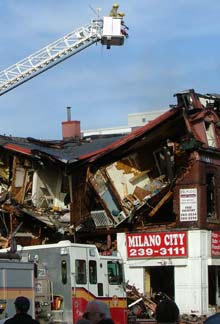
Hey, cool: That Pizza place down the street from me which has egregiously bad pizza that is egregiously expensive is no longer in business -- for the time being, at least. But seriously, 13 people are left without residence and significant damage has been wrought to a thriving commercial area surrounding Bank Street. A used book store I frequent, Book Bazaar, is right across the street. Luckily, it was spared.
Tuesday, March 15, 2005
Down to the burning city.
I’ve always had this recurring dream: I’m standing in the middle of a road looking forward into the horizon of a cityscape. I’m young—about five—and to my left is a home, rather modest, with two girls my age sitting on steps that attach to the porch. They stand in some of this dream’s different variants; they sit in others. But they’re always in the dream. To my right is a larger home. It’s were I live and I can intuitively sense this. From the cityscape a billow of smoke winds skyward—it’s as though there is a building on fire, or maybe the whole city is one fire?
The houses to my left and right are the only ones down this long road, surrounded by brush and expansive, colorful vegetation. My perspective is elevated since I’m able to look down toward the burning building or buildings or city, which are quiet a distance away. Behind me there is nothing but blue sky—blue sky that appears to have no depth whatsoever; or maybe it’s the edge of a cliff? Only a small piece of road—five feet in length, maybe—a patch of fresh grass and a bush are behind my left shoulder. It feels like the end of the world or the end of the universe is behind me—as though nothing exists beyond this point.
Or maybe it’s the beginning of existence; the start of consciousness for me. Behind me is quite possibly the unconscious slumber of thought searching for manifestation, of the “I” searching for ontology. I remember this dream because it’s historical; at least in an allegorical sense.
These are some of my first living memories. I’ve had other dreams that correspond to actual historical events in my earlier childhood, confirmed and attested to by older relatives. Sequentially, these other early dreams of childhood recollection are equivocal and contain elements of fuller spatial depth. Three dimensions of space and another one of time pervades in these recollections. In this recurring dream, I’m almost stepping into time—into existence. The two girls are historical: when I was about three I lived across from two young girls my age. We were playmates. Our home was elevated and looked down towards a cityscape.
The symbolism of this dream became far more salient as I read an essay be Slovenian Philosopher Slavoj Zizek—of Marxist Lacanian bent. (And of course, Lacan theorizes that the infant moves from the unconscious non-subjectivity to the objective “I” referent.)
In his essay, The Matrix, or, the Two Sides of Perversion, Zizek posits that the reality we attempt to escape to—away from the unreality of a capitalist consumerist paradigm—is itself an ideology. Wondering what could be behind our societal veneer, Zizek says this:
This final shot of The Truman Show may seem to enact the liberating experience of breaking out from the ideological suture of the enclosed universe into its outside, invisible from the ideological inside. However, what if it is precisely this "happy" denouement of the film (let us not forget: applauded by the millions around the world watching the last minutes of the show), with the hero breaking out and, as we are led to believe, soon to join his true love (so that we have again the formula of the production of the couple!), that is ideology at its purest? What if ideology resides in the very belief that, outside the closure of the finite universe, there is some "true reality" to be entered?
The entire essay is loaded with Lacanian jargon and inscrutable psychoanalytic allusions. Yet it is nonetheless an interesting read; humorous and measured in tone. Why I recalled my recurring dream during the essay, I’m not particularly sure. But the questions and symbols still remain. What do these two girls embody? Am I stepping into consciousness away from non-existence? And why this road down towards the burning city?
The houses to my left and right are the only ones down this long road, surrounded by brush and expansive, colorful vegetation. My perspective is elevated since I’m able to look down toward the burning building or buildings or city, which are quiet a distance away. Behind me there is nothing but blue sky—blue sky that appears to have no depth whatsoever; or maybe it’s the edge of a cliff? Only a small piece of road—five feet in length, maybe—a patch of fresh grass and a bush are behind my left shoulder. It feels like the end of the world or the end of the universe is behind me—as though nothing exists beyond this point.
Or maybe it’s the beginning of existence; the start of consciousness for me. Behind me is quite possibly the unconscious slumber of thought searching for manifestation, of the “I” searching for ontology. I remember this dream because it’s historical; at least in an allegorical sense.
These are some of my first living memories. I’ve had other dreams that correspond to actual historical events in my earlier childhood, confirmed and attested to by older relatives. Sequentially, these other early dreams of childhood recollection are equivocal and contain elements of fuller spatial depth. Three dimensions of space and another one of time pervades in these recollections. In this recurring dream, I’m almost stepping into time—into existence. The two girls are historical: when I was about three I lived across from two young girls my age. We were playmates. Our home was elevated and looked down towards a cityscape.
The symbolism of this dream became far more salient as I read an essay be Slovenian Philosopher Slavoj Zizek—of Marxist Lacanian bent. (And of course, Lacan theorizes that the infant moves from the unconscious non-subjectivity to the objective “I” referent.)
In his essay, The Matrix, or, the Two Sides of Perversion, Zizek posits that the reality we attempt to escape to—away from the unreality of a capitalist consumerist paradigm—is itself an ideology. Wondering what could be behind our societal veneer, Zizek says this:
This final shot of The Truman Show may seem to enact the liberating experience of breaking out from the ideological suture of the enclosed universe into its outside, invisible from the ideological inside. However, what if it is precisely this "happy" denouement of the film (let us not forget: applauded by the millions around the world watching the last minutes of the show), with the hero breaking out and, as we are led to believe, soon to join his true love (so that we have again the formula of the production of the couple!), that is ideology at its purest? What if ideology resides in the very belief that, outside the closure of the finite universe, there is some "true reality" to be entered?
The entire essay is loaded with Lacanian jargon and inscrutable psychoanalytic allusions. Yet it is nonetheless an interesting read; humorous and measured in tone. Why I recalled my recurring dream during the essay, I’m not particularly sure. But the questions and symbols still remain. What do these two girls embody? Am I stepping into consciousness away from non-existence? And why this road down towards the burning city?
Sunday, March 13, 2005
Who stole Ohio?
Christopher Hitchens puts on the white hat while penning a revelatory essay in March's Vanity Fair. Apropos of November 2, 2004, Hitchens delves into the voting irregularities through-out the electorally crucial state of Ohio—a state that eventually paved the way for a second Bush term. Here's an interesting excerpt:
Machines are fallible and so are humans, and shit happens, to be sure, and no doubt many Ohio voters were able to record their choices promptly and without grotesque anomalies. But what strikes my eye is this: in practically every case where lines were too long or machines too few the foul-up was in a Democratic county or precinct, and in practically every case where machines produced impossible or improbable outcomes it was the challenger who suffered and the actual or potential Democratic voters who were shortchanged, discouraged, or held up to ridicule as chronic undervoters or as sudden converts to fringe-party losers.
[...]
There are some other, more random factors to be noted. The Ohio secretary of state, Kenneth Blackwell, was a state co-chair of the Bush-Cheney campaign at the same time as he was discharging his responsibilities for an aboveboard election in his home state. Diebold, which manufactures paper-free, touch-screen voting machines, likewise has its corporate headquarters in Ohio. Its chairman, president, and C.E.O., Walden O’Dell, is a prominent Bush supporter and fund-raiser who proclaimed in 2003 that he was “committed to helping Ohio deliver its electoral votes to the president next year.” (See “Hack the Vote,” by Michael Shnayerson, Vanity Fair, April 2004.) Diebold, together with its competitor, E.S.&S., counts more than half the votes cast in the United States. This not very acute competition is perhaps made still less acute by the fact that a vice president of E.S.&S. and a Diebold director of strategic services are brothers.
Machines are fallible and so are humans, and shit happens, to be sure, and no doubt many Ohio voters were able to record their choices promptly and without grotesque anomalies. But what strikes my eye is this: in practically every case where lines were too long or machines too few the foul-up was in a Democratic county or precinct, and in practically every case where machines produced impossible or improbable outcomes it was the challenger who suffered and the actual or potential Democratic voters who were shortchanged, discouraged, or held up to ridicule as chronic undervoters or as sudden converts to fringe-party losers.
[...]
There are some other, more random factors to be noted. The Ohio secretary of state, Kenneth Blackwell, was a state co-chair of the Bush-Cheney campaign at the same time as he was discharging his responsibilities for an aboveboard election in his home state. Diebold, which manufactures paper-free, touch-screen voting machines, likewise has its corporate headquarters in Ohio. Its chairman, president, and C.E.O., Walden O’Dell, is a prominent Bush supporter and fund-raiser who proclaimed in 2003 that he was “committed to helping Ohio deliver its electoral votes to the president next year.” (See “Hack the Vote,” by Michael Shnayerson, Vanity Fair, April 2004.) Diebold, together with its competitor, E.S.&S., counts more than half the votes cast in the United States. This not very acute competition is perhaps made still less acute by the fact that a vice president of E.S.&S. and a Diebold director of strategic services are brothers.
The Godfather
News flash: The second Godfather is dreadfully overrated. Often considered one of the best sequels in contemporary cinema, the second Godfather seems, I think, to lack a unifying narrative. Don't get me wrong, it's a truly compelling story, and no doubt the treatment was moving when pitched to studio executives (obviously helped on by the success of the first Godfather) but sequentially, Coppola clumsily weaves two stories that vary in proportion.
The first, about Vito Corleone's escape from Sicily and eventual rise in New York, is proportional and persuasively portrayed by a young De Niro—proportional in that the narrative thread offers a singular progression. The second, about Don Michael Corleone's struggle to hold together a burgeoning family empire, is unproportional and plods on without a coherent or reasonable focus—it’s the height of summer one moment, then, without warning, or standard datelines, it's new year in Havana, 1959, as the city irrupts into pre-revolutionary looting; strange indeed, especially considering the stunted linearity of character development up until this point: Where was Fredo the whole time? Why wasn't a hit placed on Roth sooner? Is Senator Geary a necessary character?
The second narrative also fails in establishing a goal. We're given an ad hoc explanation as to why the Corleone family is called to testify at what, I can only guess, are Senate Hearings on criminal syndicates—although the viewer quickly understands that the Corleone family is public enemy number one. And even then, little is made of how easily Don Michael Corleone evades indictment: a reasoning that can’t even make sense of it self manifests ex nihilo.
The film seems to run out of breath far from the finish, dragging its languid corpse to the end, finally; only to appear confused and confusing. The narrative of Vito Corleone sets the table for, and amplifies the significance of, the first Godfather—despite this being done anachronistically; it’s a worthy compliment nonetheless. Michael Corleone's narrative searches for meaning and comes up wanting.
It may just be a matter of expectations and payoffs. Having not actually seen this movie, and hearing its vaunted reputation, a pristine mythology was neatly constructed around it. I had not, in any way, come across a counter assessment—or even a minority report. I expected more from this movie than it was able to deliver. It’s troubling that I wasn’t able to appreciate the film for what it was and not for what I'd expected it to be. In the final analysis, it may have been my loss for not watching it sooner.
The first, about Vito Corleone's escape from Sicily and eventual rise in New York, is proportional and persuasively portrayed by a young De Niro—proportional in that the narrative thread offers a singular progression. The second, about Don Michael Corleone's struggle to hold together a burgeoning family empire, is unproportional and plods on without a coherent or reasonable focus—it’s the height of summer one moment, then, without warning, or standard datelines, it's new year in Havana, 1959, as the city irrupts into pre-revolutionary looting; strange indeed, especially considering the stunted linearity of character development up until this point: Where was Fredo the whole time? Why wasn't a hit placed on Roth sooner? Is Senator Geary a necessary character?
The second narrative also fails in establishing a goal. We're given an ad hoc explanation as to why the Corleone family is called to testify at what, I can only guess, are Senate Hearings on criminal syndicates—although the viewer quickly understands that the Corleone family is public enemy number one. And even then, little is made of how easily Don Michael Corleone evades indictment: a reasoning that can’t even make sense of it self manifests ex nihilo.
The film seems to run out of breath far from the finish, dragging its languid corpse to the end, finally; only to appear confused and confusing. The narrative of Vito Corleone sets the table for, and amplifies the significance of, the first Godfather—despite this being done anachronistically; it’s a worthy compliment nonetheless. Michael Corleone's narrative searches for meaning and comes up wanting.
It may just be a matter of expectations and payoffs. Having not actually seen this movie, and hearing its vaunted reputation, a pristine mythology was neatly constructed around it. I had not, in any way, come across a counter assessment—or even a minority report. I expected more from this movie than it was able to deliver. It’s troubling that I wasn’t able to appreciate the film for what it was and not for what I'd expected it to be. In the final analysis, it may have been my loss for not watching it sooner.
Friday, March 11, 2005
Della
In the fiction section of the New Yorker online there's this rather cute finish to a tightly written, quietly poignant short story by Anne Enright:
And it seemed so absurd to Della—the thirty years that these things mattered, out of the eighty years that made up a life, eighty or more—that she found herself laughing out loud.
“What’s the joke?” he said.
“Nothing,” she said.
“Don’t let me stop you,” he said.
“I won’t, so,” she said.
And he turned his face to her; gleeful, as if he could see her quite clearly—a woman in his kitchen who was far from being a virgin, a woman who would, no doubt, find him quite attractive, in the end.
It has always intrigued me how a carefully constructed series of sentences--in the coherence of a story, linear or not--evokes a clutch of different feelings.
And it seemed so absurd to Della—the thirty years that these things mattered, out of the eighty years that made up a life, eighty or more—that she found herself laughing out loud.
“What’s the joke?” he said.
“Nothing,” she said.
“Don’t let me stop you,” he said.
“I won’t, so,” she said.
And he turned his face to her; gleeful, as if he could see her quite clearly—a woman in his kitchen who was far from being a virgin, a woman who would, no doubt, find him quite attractive, in the end.
It has always intrigued me how a carefully constructed series of sentences--in the coherence of a story, linear or not--evokes a clutch of different feelings.
Thursday, March 10, 2005
The Yes Men
I just finished watching an incredibly hilarious film that I’m surprised I hadn’t heard of earlier(It was released in 2003). The Yes Man—a mockumentary in Michael Mooresuque fashion—follows two ingenious and creative anti-globalization activists posing as WTO representatives from Paris, to Finland, to New York, places in between, and then finally to Australia where they dramatically announce the dissolution of the WTO.
The Yes Men, Mike Bonanno and Andy Bichlbaum, are invited to speak at a number of international conferences on matters of multilateral trade policy—this, of course, on the strength of their faux WTO website that actually criticizes WTO practices. Conference organizers, who clearly neglect to authenticate the veracity of Bonanno and Bichlhaum’s site, fall pray to the Yes Men’s use of irony, with a tough of abject realism, to openly mock conference members and convey what they feel to be the actual function of the WTO: To beggar poor nations for the benefit of large multinational corporations.
The most side splittingly funny part of the film, for me at least, came when Andy Bichlbaum (impersonating a WTO representative) explained to an assembled group of conference members that the American Civil War was unnecessary, since natural market forces would have solved the icky problem of slavery. Covered in a gold spandex body suit, with a phallic shaped inflatable shaft protruding from his crotch, Bichlbaum also introduce conference members to the future of efficient management: A skin tight leisure suit that allows managers—through a protruding shaft that contains a computer screen at its tip—to monitor the every move of employees all over the world—employees who’ve been implanted with an electronic sensory chip that corrects intransigent employees with electrical shocks, naturally. This consequently frees up more leisure time for managers to ski, enjoy sunsets, and pop champagne, as the Yes Men’s comically professional power point illustrates.
Needless to say, the film is irreverent and thoughtfully evocative. Beneath the easy smiles of anti-corporatist pranksterism lies a deadly serious and obtusely understood issue: Globalization’s discontents will soon register their appeals to the WTO un-reality based paradigms. I’m not usually a Cassandra; but if what’s going on in Latin American is any portent, then a sea change in international affair is likely taking place. Very, very sleepy; cogency slowly diminishing.
The Yes Men, Mike Bonanno and Andy Bichlbaum, are invited to speak at a number of international conferences on matters of multilateral trade policy—this, of course, on the strength of their faux WTO website that actually criticizes WTO practices. Conference organizers, who clearly neglect to authenticate the veracity of Bonanno and Bichlhaum’s site, fall pray to the Yes Men’s use of irony, with a tough of abject realism, to openly mock conference members and convey what they feel to be the actual function of the WTO: To beggar poor nations for the benefit of large multinational corporations.
The most side splittingly funny part of the film, for me at least, came when Andy Bichlbaum (impersonating a WTO representative) explained to an assembled group of conference members that the American Civil War was unnecessary, since natural market forces would have solved the icky problem of slavery. Covered in a gold spandex body suit, with a phallic shaped inflatable shaft protruding from his crotch, Bichlbaum also introduce conference members to the future of efficient management: A skin tight leisure suit that allows managers—through a protruding shaft that contains a computer screen at its tip—to monitor the every move of employees all over the world—employees who’ve been implanted with an electronic sensory chip that corrects intransigent employees with electrical shocks, naturally. This consequently frees up more leisure time for managers to ski, enjoy sunsets, and pop champagne, as the Yes Men’s comically professional power point illustrates.
Needless to say, the film is irreverent and thoughtfully evocative. Beneath the easy smiles of anti-corporatist pranksterism lies a deadly serious and obtusely understood issue: Globalization’s discontents will soon register their appeals to the WTO un-reality based paradigms. I’m not usually a Cassandra; but if what’s going on in Latin American is any portent, then a sea change in international affair is likely taking place. Very, very sleepy; cogency slowly diminishing.
Wednesday, March 09, 2005
Latin America
Dispatches from the frontline of the ever expanding global village: First, from the Economist, an article about the economic turnaround Brazil is experiencing strikes a cautionary tone-government outlay shouldn’t be increased to the detriment of international investors:
Non-financial spending by the federal government rose by 11% in real terms last year, with big rises in areas that do nothing to strengthen long-term growth prospects. Lula added workers to the federal payroll, one reason why spending on personnel rose by 5% last year. Keeping an old promise, he will raise the official minimum wage by 8% to 300 reais ($115) a month, which will push up the cost of publicly financed pensions and benefits by 4 billion reais a year, says Raul Velloso, a budget expert in Brasília.
[...]
Yet some Brazilians [which ones?-ed.] worry about what would happen if investors lose their current appetite for risk. They reckon the government should be moving to cut its debt more swiftly, allowing interest rates to fall. In a rare comment on budget policy, the central bank recently said that “reductions in public spending [would] reinforce monetary policy in controlling inflation.” The latest data suggest that the economy is already slowing, which may mean that the bank can soon stop raising rates.
The sagacious benevolence of the IMF is eternal. From the article-- which is entitled The dangers of tax and spend-- is this infectiously cute cartoon of Brazil’'s president Luiz Inácio Lula da Silva:
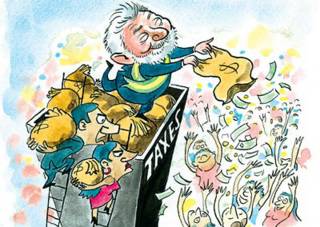
Over in Bolivia, President Carlos Mesa has stepped down as a result of the electorate-70% of which is constituted by indigenous, native Indians-agitating for economic and political recognition. From the Independent:
Faced with a national strike aimed at forcing international energy companies to pay much higher taxes, Mr. Mesa made what was seen as last-ditch effort to get his opponents to back down.
[....]
The former historian pointed the finger of blame for the crisis at Evo Morales, a coca farmer and leader of the populist Movement to Socialism (MAS), who he accused of turning the landlocked nation of 8 million into a "country of ultimatums".
Mr. Morales has led calls for a blockade stretching to every corner of the remote and isolated Andean country unless the government raises taxes on foreign energy companies exporting oil and gas to 50 per cent. The President has rejected the demand, saying foreign multinationals would take Bolivia to court, with disastrous consequences.
[....]
A regional analyst, Mark Schneider, from the International Crisis Group, said Bolivia was facing its "greatest crisis" in years. "The current issue may be drugs, gas or pipelines but the core is [respective] governments' failure to incorporate the majority of people into political life and it is coming back to haunt them," he said.
Globalization'’s discontents register their appeal.
Non-financial spending by the federal government rose by 11% in real terms last year, with big rises in areas that do nothing to strengthen long-term growth prospects. Lula added workers to the federal payroll, one reason why spending on personnel rose by 5% last year. Keeping an old promise, he will raise the official minimum wage by 8% to 300 reais ($115) a month, which will push up the cost of publicly financed pensions and benefits by 4 billion reais a year, says Raul Velloso, a budget expert in Brasília.
[...]
Yet some Brazilians [which ones?-ed.] worry about what would happen if investors lose their current appetite for risk. They reckon the government should be moving to cut its debt more swiftly, allowing interest rates to fall. In a rare comment on budget policy, the central bank recently said that “reductions in public spending [would] reinforce monetary policy in controlling inflation.” The latest data suggest that the economy is already slowing, which may mean that the bank can soon stop raising rates.
The sagacious benevolence of the IMF is eternal. From the article-- which is entitled The dangers of tax and spend-- is this infectiously cute cartoon of Brazil’'s president Luiz Inácio Lula da Silva:
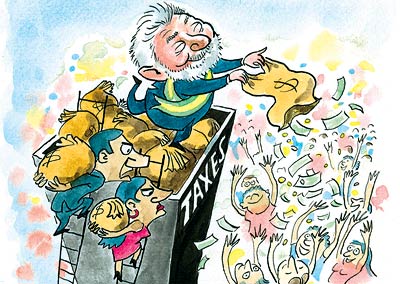
Over in Bolivia, President Carlos Mesa has stepped down as a result of the electorate-70% of which is constituted by indigenous, native Indians-agitating for economic and political recognition. From the Independent:
Faced with a national strike aimed at forcing international energy companies to pay much higher taxes, Mr. Mesa made what was seen as last-ditch effort to get his opponents to back down.
[....]
The former historian pointed the finger of blame for the crisis at Evo Morales, a coca farmer and leader of the populist Movement to Socialism (MAS), who he accused of turning the landlocked nation of 8 million into a "country of ultimatums".
Mr. Morales has led calls for a blockade stretching to every corner of the remote and isolated Andean country unless the government raises taxes on foreign energy companies exporting oil and gas to 50 per cent. The President has rejected the demand, saying foreign multinationals would take Bolivia to court, with disastrous consequences.
[....]
A regional analyst, Mark Schneider, from the International Crisis Group, said Bolivia was facing its "greatest crisis" in years. "The current issue may be drugs, gas or pipelines but the core is [respective] governments' failure to incorporate the majority of people into political life and it is coming back to haunt them," he said.
Globalization'’s discontents register their appeal.
Tuesday, March 08, 2005
Hyper-speed prediction-falsification
Ealier today, Matt Yglesias commented on the problem of hyper-speed prediction-falsification with respect to an article by Reuel Marc Gerecht in the current issue of the Weekly Standard. It's apt that the same thing should happen to me also--even if only slightly. The Cavs beat the Magic 111-92.
The boy who was to be King.
Don't mind me while I relish the perpetual decline of the once vaunted—and unjustifiably so—Cavaliers of Cleveland. Going into this year’s All-Star break, fawning stories about the transformation of the Cavs, helped by the young uber-star Lebron James, abounded. I'm not one for Shaundenfreud—though I’m always up for some good gloating—but during the Cavaliers distorted success many of my friends were heaping encomiums on the untested Lebron James. They marveled at his incredible maturity, his keen basketball intellect, and his superior statically production. I, however, only saw merit in his physical prowess—something he was blessed with; a “type-fact”, as Nietzsche would say.
It then occurred to me that this is all people really admire in the young man. All the hype, all the adulation seems to be predicated on his physicality—and, likewise, his youth. It’s like being captivated by a baby because it’s so young, or, more, topically, by Shaq for being extremely large, physically.
So, what then is the difference between Shaq and Lebron, you ask? Well, for one—actually, for three—Shaq has an NBA championship ring; three of them, to be exact. Lebron has none, and isn’t likely to win one until Shaq retires.
Thus, my particular problem with Lebron—the concept, not the person—is that expectations have already exceed what, unfortunately, he’ll ever accomplish. While Kobe still tries to create his own legendary mythology (slightly tarnished now, for obvious reasons) Lebron has yet to grope his way into the playoff and pay his dues. People should give this kid a chance to prove himself before anointing him or conferring on him any title fitting for a King.
The Cavs have been riding a six-game losing streak and appear to be discordant organizationally. Tonight, they play the Orlando Magic and will be hard pressed to prove whether or not they’re going to break out of the funk, or slip further into Eastern Conference obscurity.
It then occurred to me that this is all people really admire in the young man. All the hype, all the adulation seems to be predicated on his physicality—and, likewise, his youth. It’s like being captivated by a baby because it’s so young, or, more, topically, by Shaq for being extremely large, physically.
So, what then is the difference between Shaq and Lebron, you ask? Well, for one—actually, for three—Shaq has an NBA championship ring; three of them, to be exact. Lebron has none, and isn’t likely to win one until Shaq retires.
Thus, my particular problem with Lebron—the concept, not the person—is that expectations have already exceed what, unfortunately, he’ll ever accomplish. While Kobe still tries to create his own legendary mythology (slightly tarnished now, for obvious reasons) Lebron has yet to grope his way into the playoff and pay his dues. People should give this kid a chance to prove himself before anointing him or conferring on him any title fitting for a King.
The Cavs have been riding a six-game losing streak and appear to be discordant organizationally. Tonight, they play the Orlando Magic and will be hard pressed to prove whether or not they’re going to break out of the funk, or slip further into Eastern Conference obscurity.
Monday, March 07, 2005
It's the Guns stupid.... and the criminal background too.
Colby Cosh has been nearly unflappable over at the Shotgun (a.k.a the echo chamber) and at his own site, ColbyCosh.com, following the fall-out that has attended the killing of four RCMP officers in Mayerthorpe, Alberta. An incredible conflation of the facts has been committed by Socon's (social conservatives) jumping, self-righteously, on the word marijuana as though it were alone the causa effectiva. Socon’s have neglected the fact that Mr. Roszko was "running a chop-shop for stolen cars", and handling something to the order of 20 grams of marijuana—hardly the type of weight worthy of being called a grow-op.
Even more, reactionaries from both ends of the political spectrum are eliding the body of evidence that is Mr. Roszko criminal record, which is indicative of his deviant pathology rather than reflective of the putative lax criminal penalties for operators of "grow-ops"—as if this incident were actually that one-dimensional.
Interestingly enough, Cosh is indefatigably burnishing his libertarian cred while dispensing forth on the merits of not only decriminalizing marijuana but legalizing and controlling the distribution of it—as it would deracinate the criminal-cartels from the process and prove fiscally salubrious for revenue strapped governments. Cosh draws the usual historical parallels between the flourishing of criminal syndicates during prohibition to the current state of our drug enforcement policy—the War on drugs, and whatnot—which is apt and instructive in light of the Mayerthorpe tragedy: criminal actors had an incredible economic incentive to bootleg alcohol since its criminalization both created a black market and inflated its price.
No doubt more ink will be spilled on the advantages and disadvantages of a more intelligent and contextually practicable drug (marijuana) policy. But the real issue, I think, that may avoid sober analysis is whether the four RCMP officers were prepared for what was to befall them that night? And, in a similar vain, whether people with the unsavory criminal background of a Mr. Roszko should register their weapons to a, let’s say, national gun registry —let alone own them.
Even more, reactionaries from both ends of the political spectrum are eliding the body of evidence that is Mr. Roszko criminal record, which is indicative of his deviant pathology rather than reflective of the putative lax criminal penalties for operators of "grow-ops"—as if this incident were actually that one-dimensional.
Interestingly enough, Cosh is indefatigably burnishing his libertarian cred while dispensing forth on the merits of not only decriminalizing marijuana but legalizing and controlling the distribution of it—as it would deracinate the criminal-cartels from the process and prove fiscally salubrious for revenue strapped governments. Cosh draws the usual historical parallels between the flourishing of criminal syndicates during prohibition to the current state of our drug enforcement policy—the War on drugs, and whatnot—which is apt and instructive in light of the Mayerthorpe tragedy: criminal actors had an incredible economic incentive to bootleg alcohol since its criminalization both created a black market and inflated its price.
No doubt more ink will be spilled on the advantages and disadvantages of a more intelligent and contextually practicable drug (marijuana) policy. But the real issue, I think, that may avoid sober analysis is whether the four RCMP officers were prepared for what was to befall them that night? And, in a similar vain, whether people with the unsavory criminal background of a Mr. Roszko should register their weapons to a, let’s say, national gun registry —let alone own them.
Friday, March 04, 2005
Martha, Martha, Martha!!
Martha Stewart was just released from prision today and one could be led to believe, with all the ridiculous fanfare, that she was, instead, wrongfully convicted and did not, in fact, lie to federal investigators. To clear things up, she did, in fact, lie to federal investigators. For the next five months Ms. Stewart will be under house arrest in her plush, $16 million dollar Katonah estate in New York -- during which time she'll have the opporunity to accessorize the electronic ankle braclet that will monitor her every move. In addition, she'll be developing an Apprenticesque network show for NBC.
It's hearting to see an ex-con so quickly intergate back into civil society. Naturally, the court of public opinion is all that truly matters for Martha, as it's incredibly unlikely she'll have a problem finding gainful employment because of her criminal record.( Although, SEC regulations my prohibit her from helming a publicly traded company.) Look for a softer more endearing Martha Stewart in the months that follow, as she rolls out a public relations blitz to re-brand her hard, brusque image. So, much like I predicted in December's Year in Review, Martha Stewart will soon become an American folkhero.
It's hearting to see an ex-con so quickly intergate back into civil society. Naturally, the court of public opinion is all that truly matters for Martha, as it's incredibly unlikely she'll have a problem finding gainful employment because of her criminal record.( Although, SEC regulations my prohibit her from helming a publicly traded company.) Look for a softer more endearing Martha Stewart in the months that follow, as she rolls out a public relations blitz to re-brand her hard, brusque image. So, much like I predicted in December's Year in Review, Martha Stewart will soon become an American folkhero.
Subscribe to:
Posts (Atom)